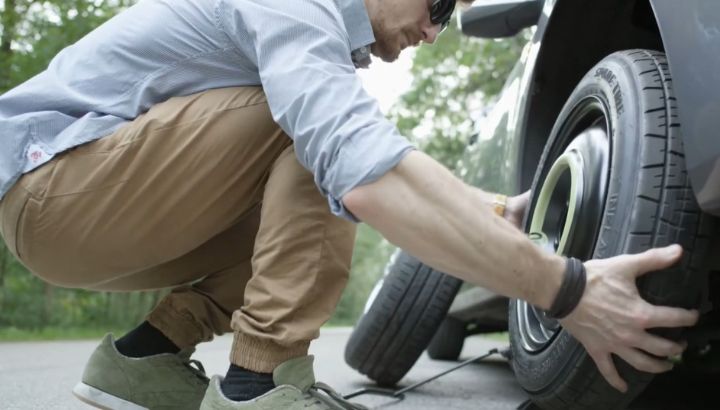
Check your tread depth: below 2/32 inch, replace your tires now. Read your DOT code: if your tires are over 6 years old, replace them. Spot sidewall cracks, bulges, or vibration: stop driving and replace immediately.
You probably wait too long to change your tires, and that risks a blowout, hydroplaning, or a failed inspection.
In the next few minutes, you will learn how to read your own tread depth, DOT date, sidewall condition, and pressure so you know exactly when your next tire change is due.
Symptoms You Will Notice Before Your Tires Need Replacement
Your tires almost never fail without warning you first. Your steering wheel, your seat, and your dashboard all communicate wear long before a blowout happens.
If you catch these signs early, you save money and avoid emergencies on the highway.
Reduced Tread Depth Below Safe Limits
Your new passenger tires start at 10/32 inch to 11/32 inch of tread. The legal minimum where you drive is usually 2/32 inch under DOT FMVSS 139, but your braking distance increases sharply once you fall below 4/32 inch on wet roads.
You can use a tread depth gauge or the classic penny test (if you can see Lincoln’s head, you replace). Your performance tires, all-season tires, and winter tires wear at different rates, but the rule is the same for you: less rubber equals less grip and longer stopping distance when you need it most.
Vibration, Pulling, And Steering Wheel Wobble
If your steering wheel vibrates between 50 to 70 mph, you likely have uneven wear, a bent rim, or an out of balance wheel. If your car pulls left or right, you are dealing with misalignment, low tire pressure, or a damaged internal belt inside the carcass.
If you hear a growling or roaring sound that changes when you steer, you have a worn tire, not a bad wheel bearing.
Sidewall Cracks, Bulges, And Dry Rot
If you see sidewall cracking on your tires, you are looking at UV and ozone damage from parking outside. If you spot a bulge, you have a separated internal cord, and that is a ticking time bomb at highway speed.
Both cases demand immediate replacement under NHTSA guidance, no exceptions for you.
Loss Of Pressure Or Frequent Refilling
If your tire loses more than 1 to 2 PSI per month, you have a slow leak, valve stem failure, bead seal issue, or a porous sidewall.
If your TPMS warning light triggers, your pressure has already dropped 25 percent below spec, and your tire is heat damaged inside.
What These Symptoms Mean For Your Tire Lifespan
Each symptom you see maps directly to a failure mechanism.
If you read them correctly, you avoid buying tires too early and you avoid driving on dangerous ones too long.
Tread Wear Patterns And What They Reveal About Your Driving
If you see center wear, you are running chronic over inflation. If you see edge wear on both shoulders, you are under inflated. If you see one-sided wear, you have bad camber or toe alignment.
If you see cupping or scalloping, your shocks or struts are worn. If you see feathering across tread blocks, your tie rods are bad.
The pattern tells you the underlying mechanical issue, and if you ignore it, your next set wears out just as fast.
Age Based Rubber Degradation On Your Vehicle
Even if you barely drive, your tires age. Rubber compounds oxidize, internal oils evaporate, and the carcass hardens.
Major manufacturers including Michelin, Bridgestone, Continental, Goodyear, and Pirelli recommend you replace at 6 years regardless of tread, with a hard cap at 10 years. The U.S. Tire Manufacturers Association (USTMA) echoes this guidance for you.
Check your DOT code stamped on the sidewall: the last four digits show week and year of manufacture. If you read “2322,” that means the 23rd week of 2022.
Mileage Based Wear Curves For Your Tire Type
Your typical all season tire lasts 50,000 to 70,000 miles. Your performance summer tires last 20,000 to 40,000 miles. Your winter tires last 30,000 to 40,000 miles.
Your touring tires with high UTQG treadwear ratings (600 plus) can exceed 80,000 miles. The mileage warranty from your manufacturer is your baseline reference.
If you drive aggressively, in hot climates, or under heavy loads, you cut these numbers significantly. If you own a Tesla Model Y or any EV, your tires wear faster because of instant torque and battery weight.
Identify The Exact Problem: Your Diagnostic Flow
Before you buy new tires, you need to confirm whether you actually need replacement, rotation, alignment, or rebalancing.
If you misdiagnose, you spend hundreds on parts you never needed.
Step 1: Measure Your Tread Depth On All Four Tires
Use your digital tread gauge or the TWI (tread wear indicator) bars built into your tire. Measure the inner, center, and outer grooves on each tire and record your values.
If any single point reads below 2/32 inch, that tire is finished and you replace it now.
Step 2: Inspect Your Sidewall And DOT Date
Look for cracks, bubbles, gouges, exposed cords, or embedded objects like nails or screws. Read your DOT code.
If your tires are older than 6 years, you replace them even if tread is healthy, especially if you live in a hot climate where rubber breaks down faster from ozone exposure.
Step 3: Check Your Pressure Cold
Use a quality digital tire pressure gauge. Match your readings to the door jamb sticker, never the sidewall maximum.
Your typical passenger car PSI runs 30 to 35 PSI front and rear. If you have pressure differences between sides, you cause pulling and create false wear diagnoses on alignment racks.
Step 4: Test Drive For Symptoms
Drive on a flat, straight road at 40, 60, and 70 mph. Note any vibration, noise pitch, and pulling you feel.
If you only feel vibration during braking, your brake rotors are warped, not your tires. If your vibration is tied to road speed but not engine speed, you almost certainly have a wheel or tire issue.
Symptom To Cause To Fix Diagnostic Table
| Symptom | Likely Cause | Fix |
|---|---|---|
| Tread below 4/32 inch | Normal wear | Replace your tires |
| Tread below 2/32 inch | Worn beyond legal limit | Replace immediately |
| Center wear strip | Over inflation | Set correct PSI, replace if worn out |
| Both edges worn | Chronic under inflation | Inflate to spec, check for leaks |
| One side wear | Misalignment (camber or toe) | Get a wheel alignment, replace tire |
| Cupping or scalloping | Worn shocks or struts | Replace your suspension, then your tires |
| Feathered tread | Bad tie rod or toe out | Replace tie rod, align, replace tire |
| Vibration at 60 mph | Out of balance wheel | Rebalance |
| Vibration during braking | Warped rotor (not tire) | Resurface or replace your rotor |
| Sidewall bulge | Internal belt separation | Replace your tire immediately |
| Sidewall cracks | UV or ozone dry rot | Replace if cracks exceed 2mm depth |
| Slow PSI loss | Valve stem or bead leak | Reseat or replace stem; replace tire if porous |
| Tire 6 plus years old | Rubber aging | Replace regardless of tread |
| Pulling to one side | Alignment or pressure mismatch | Equalize PSI, then align |
| TPMS warning light | Low pressure or sensor fail | Inflate, scan with OBD2, replace sensor if needed |
Step By Step Fix Based On Your Condition
The right fix depends on what your diagnosis revealed.
Match your action to your symptom precisely so you do not pay for parts you never needed.
Tools You Will Need
You need a tread depth gauge, digital tire pressure gauge, torque wrench calibrated to 80 to 100 ft lbs for most passenger cars, hydraulic floor jack, jack stands, lug wrench or impact wrench, chalk for marking rotation positions, and an OBD2 scanner if your TPMS warning light is on.
A multimeter helps you diagnose TPMS sensor battery life on your aging vehicle. The Hunter Road Force Elite balancer is what you should ask for at your shop.
Fix 1: Tire Rotation Every 5,000 To 7,500 Miles
If you rotate, you even out wear and extend tire life by up to 25 percent. On your front wheel drive vehicle, you use the forward cross pattern.
On your rear wheel and AWD drive, you use the rearward cross. If you have directional tires, you only swap front to back on the same side.
Always torque your lugs in a star pattern to manufacturer spec, never with an impact gun set to maximum.
Fix 2: Full Tire Replacement
You should always replace in pairs minimum, all four ideally, especially if you have an AWD vehicle where mismatched tread depths damage your transfer case and differential.
Match the original size, load index, and speed rating stamped on your door jamb. Reset your TPMS after installation.
Have your wheels balanced and request a road force balance for premium results, which detects defects a standard balance misses.
Fix 3: Alignment After New Tires
Get a four wheel alignment if you noticed pulling, uneven wear, or replaced suspension parts. Your specs include camber, caster, and toe, all measured in degrees.
Modern alignment racks like the Hunter HawkEye Elite print before and after values for you. Insist on seeing them before you pay.
A bad alignment can chew your new tire in under 10,000 miles.
Fix 4: TPMS Sensor Replacement
Your TPMS sensors run on internal batteries lasting 5 to 10 years. If your sensor fails after a tire change, you replace it during the same service to avoid double labor.
Schrader, VDO, and Continental sensors are common original equipment on your vehicle. Aftermarket programmable sensors from Autel and Dorman save you money on multi vehicle households.
When This Fix Will Not Work
Replacing your tires solves your tire problems.
It does not solve everything that feels like a tire problem to you.
Suspension Damage Mimicking Your Tire Wear
If you install new tires and still feel cupping vibration or harshness within 5,000 miles, your shocks, struts, control arm bushings, or ball joints are worn. Your new rubber wears out just as fast.
Always inspect your suspension before you spend on new tires when cupping is present. Bilstein, KYB, and Monroe are common replacement strut brands you can install.
Bent Wheel Or Damaged Rim
If you have a pothole-bent rim, you cannot balance it reliably. You will feel vibration even with brand new tires installed.
Inspect your rims with a runout gauge or have your shop check them. You can sometimes straighten bent steel rims, but you usually replace alloy wheels for safety.
Drivetrain Or Brake Vibration
If you only feel vibration during braking, your brake rotors are warped, not your tires. If your vibration changes with throttle but not road speed, your driveshaft, U joint, or CV axle is worn.
If you feel vibration at idle in gear, you have bad engine mounts, not bad tires.
Best Tools And Tire Brand Comparison
Choosing your right replacement tire matters as much as timing it correctly.
Lifespan, grip, comfort, and price all vary significantly by category, so you match your tire to your driving.
| Tire Type | Typical Lifespan | Best For You If | Example Brands | UTQG Treadwear |
|---|---|---|---|---|
| Standard all season | 50,000 to 70,000 mi | You commute daily | Michelin Defender, Goodyear Assurance | 700 to 820 |
| Grand touring | 60,000 to 85,000 mi | You drive highways | Continental TrueContact, Bridgestone Turanza | 700 to 800 |
| Performance summer | 20,000 to 40,000 mi | You drive a sport sedan | Michelin Pilot Sport, Pirelli P Zero | 200 to 340 |
| All terrain | 40,000 to 60,000 mi | You own a truck or SUV | BFGoodrich KO2, Falken Wildpeak | 500 to 600 |
| Winter or snow | 30,000 to 40,000 mi | You face snow or ice | Bridgestone Blizzak, Nokian Hakkapeliitta | N/A (3PMSF rated) |
| Run flat | 40,000 to 50,000 mi | You drive a BMW or MINI | Bridgestone DriveGuard, Pirelli RFT | 400 to 600 |
Essential Diagnostic Tools You Should Own
Pick up a Milton S-921 pencil gauge or JACO ElitePro digital gauge for pressure checks. Get an Accutire MS-4350B for tread depth.
A Stanley FATMAX torque wrench handles your lugs at correct spec. The Autel TS508 manages your TPMS resets.
A simple OBD2 scanner like BlueDriver or Innova 5610 lets you diagnose ABS and TPMS faults you might otherwise blame on your tires.
Mistakes That Make Your Tire Wear Worse
Even if you mean well, you shorten your tire life by repeating the same mistakes.
Avoid these and your tires will outlast your warranty.
Ignoring The Door Jamb Pressure Spec
The PSI printed on your sidewall is maximum, not recommended. Always inflate to your door jamb value when your tires are cold.
If you over inflate, you reduce contact patch and wear the center strip. If you under inflate, you generate excessive heat, cause shoulder wear, and dramatically increase blowout risk on hot summer highways.
Mixing Tire Sizes Or Tread Patterns
If you mix tires, you confuse your ABS, traction control, and AWD systems.
On your AWD vehicle, a tread depth difference of more than 2/32 inch between tires can damage your transfer case and differential, and that repair bill often exceeds the price of a full new tire set.
Skipping Rotation
Your front tires on a FWD car wear roughly twice as fast as your rear tires. If you skip rotation, you replace four tires when you could have evened wear and bought only two.
Pair your rotation with engine oil changes to make the schedule automatic for you.
Driving On A Spare For Too Long
Your donut spare is rated for 50 miles at 50 mph. If you drive longer, you destroy your differential, the spare itself, and create a real safety hazard.
You can drive longer on full size spares but you should rotate them into your regular set to prevent age based degradation while sitting unused.
Buying Old Stock Tires
If you buy tires that sat in a warehouse for 3 years, you are already a third of the way through useful life before installation. Always check your DOT code before purchase and refuse anything over 12 months old.
Reputable retailers like Tire Rack, Discount Tire, and Costco rarely stock old inventory, but local shops sometimes do.
How To Prevent Premature Tire Replacement
Prevention is cheaper than replacement for you.
Follow this loop and your tires will go the full distance.
Monthly Pressure Checks
Check your pressure on all four tires plus the spare every month, cold. Your pressure drops about 1 PSI per 10°F temperature change, which is why your low pressure warning triggers in winter.
Keep a quality gauge in your glove box and use it the same day each month.
Rotation Every 5,000 To 7,500 Miles
Pair your rotation with synthetic oil changes for easy memory. Most quick lube shops include free rotation with your oil service.
A Castrol Edge, Mobil 1, Pennzoil Platinum, or Shell Rotella oil change at viscosity grades like SAE 5W-30 or 0W-20 is a perfect pairing schedule for your tire rotation.
Annual Alignment Check
Get a quick alignment check after you hit a major pothole, curb impact, or install new suspension parts. You prevent thousands of miles of uneven wear.
The check costs you $80 to $150 and pays for itself in tire life. The SAE J670 standard defines alignment terminology used by every shop you visit.
Real Life Scenario
You drive a Toyota Camry and notice steering vibration at 65 mph and pulling right. Your tread looks fine at 6/32 inch.
When you diagnose, you find the right front has cupping wear, your DOT code shows tires are 7 years old, and your front struts have over 90,000 miles.
Your fix involves replacing all four tires with Michelin Defender 2, replacing both front struts with KYB GR-2 units, and performing a four wheel alignment.
Your vibration disappears, your tire life extends to the full warranty, and your total cost stays lower than two more rounds of premature replacement.
Frequently Asked Questions
How Often Should You Change Your Tires On Average?
You should replace your tires every 3 to 5 years or every 50,000 to 70,000 miles, whichever comes first. The exact interval depends on your tire type, driving habits, road conditions, and climate.
If you run performance tires, you replace sooner, often around 25,000 miles, while your touring tires can exceed 80,000 miles. Always inspect your tread depth monthly and check the DOT date code annually.
If your tires are older than 6 years, replace them even if tread looks healthy, because rubber degrades chemically with age and your grip drops sharply once dry rot begins on the sidewalls.
Can You Replace Just One Tire Instead Of All Four?
You can replace one tire on a front wheel drive or rear wheel drive car only when your other three have nearly full tread within 2/32 inch.
If you drive an AWD vehicle, mismatched tread depth forces your differential and viscous coupling to work harder, leading to expensive drivetrain damage. The safest practice for you is replacing tires in matched pairs on the same axle.
If your AWD vehicle loses one tire early, ask your shop about tire shaving, where they machine a new tire down to match your existing tread depth.
What Does The DOT Code On Your Tire Mean?
Your DOT code is stamped on your tire sidewall and identifies the manufacturing plant, size, and date of production. The last four digits matter most because they represent the week and year.
If you read “0823,” that means the 8th week of 2023. If your tires are older than 6 years from this date, you replace them regardless of how your tread looks, because the rubber compound has hardened, oils have evaporated, and your grip in wet or cold conditions has dropped significantly.
Always check this code when you buy tires, especially used or warehouse stock.
How Do You Know If Your Tires Are Over Inflated Or Under Inflated?
Check your pressure cold using a calibrated digital tire pressure gauge, then compare to the value on your driver door jamb sticker, not the tire sidewall.
If you under inflate, both shoulders wear faster, you generate excessive heat, and you increase blowout risk. If you over inflate, the center strip wears and your grip reduces because the contact patch shrinks.
Most passenger vehicles need 30 to 35 PSI. Your truck or SUV may run higher. Your TPMS light typically triggers when pressure drops 25 percent below spec, but by then your tire is already damaged inside.
Do Your Tires Expire Even If You Do Not Drive Much?
Yes. Your rubber chemistry breaks down whether tires roll or sit. UV light, ozone, heat, and oxygen all attack the polymer chains in your tires.
If you drive only 3,000 miles a year, your tires age out before they wear out. Look for sidewall cracks, especially at the base of your tread blocks.
Manufacturers including Michelin, Bridgestone, and Continental advise you to replace at 6 years and impose a hard limit of 10 years from your DOT date. Your spare tire, often forgotten in the trunk well, falls under the same aging rule.
Why Are Your New Tires Wearing Out Faster Than Expected?
If your new tires wear fast, you almost always have misalignment, worn suspension, incorrect inflation, or aggressive driving.
Check your camber and toe specifications first, as a half degree of bad toe can chew your tire in 10,000 miles. If your shocks or struts are worn, your tire bounces and you create cupping.
If you corner hard, launch from stops, or panic brake, you accelerate wear. Track your monthly PSI, rotate every 5,000 to 7,500 miles, and have your alignment checked once a year or after any pothole impact to protect your investment.
Should You Use Winter Tires Or All Season Tires?
If your temperatures regularly drop below 7°C (45°F), dedicated winter tires outperform your all seasons by a wide margin.
Winter compounds stay flexible in cold, while your all season rubber hardens and loses grip. Bridgestone Blizzak, Michelin X Ice, and Nokian Hakkapeliitta are top performers for you.
If you live in a moderate climate without snow or ice, premium all seasons such as Michelin CrossClimate 2 offer year round capability with light winter performance. Never mix winter and all season tires on different axles, because the grip mismatch can cause unpredictable handling during emergency maneuvers.
How Much Does It Cost You To Replace Tires?
Your tire prices vary widely. Economy all seasons run $80 to $120 per tire, mid range touring tires $130 to $200, and premium performance tires $200 to $400 or more.
Add $20 to $30 per tire for mounting, balancing, valve stems, and disposal fees. Your four wheel alignment costs $80 to $150.
Your run flat tires for BMW, Lexus, and other OE applications can exceed $300 per tire. Always include alignment and TPMS service in your budget. If you buy online from Tire Rack or Discount Tire and use a local installer, you often save 15 to 25 percent.
Is It Safe For You To Drive On Tires With Cracks In The Sidewall?
If your cracks are small and superficial, your weather checking is not immediately dangerous, but if your cracks reach deeper than one millimeter or expose internal cords, your tire is unsafe.
Sidewall cracking signals dry rot, meaning your rubber has lost flexibility and structural integrity is compromised. Your blowout risk rises sharply at highway speeds, especially in summer heat.
If you see deep cracks, bulges, or any exposed fabric or steel cords, stop driving the vehicle and replace your tire immediately. No repair patches your sidewall safely. Your sidewall damage is never repairable under any circumstances.
Conclusion
You should replace your tires every 3 to 5 years or when your tread reaches 2/32 inch, whichever comes first, with a hard age cap at 6 years for full safety.
Diagnose by reading your tread depth, checking your DOT code, inspecting your sidewalls, and observing your wear patterns. Match your fix to your cause: replace for worn rubber, align for uneven wear, rebalance for vibration, and replace your suspension when cupping returns.