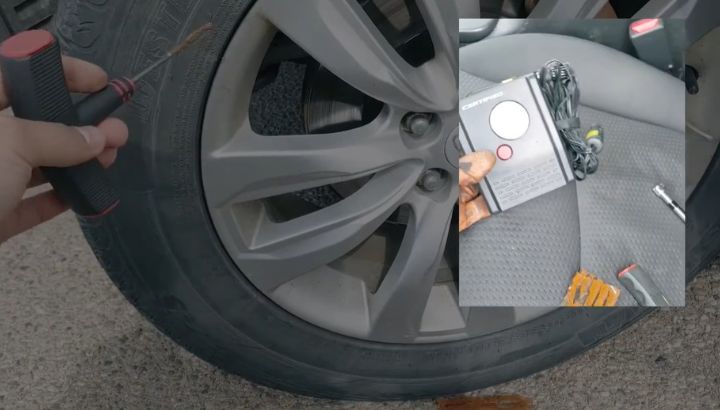
An external DIY tire plug lasts 7 to 10 years or 25,000 miles. A professional internal patch-plug lasts the full life of the tire (50,000 to 80,000 miles). Lifespan depends on installation method, puncture location, and driving habits.
You stuck a plug in your tire last summer and now you are wondering if you are driving on borrowed time.
The honest answer depends on whether the plug went in from the inside or the outside, who installed it, and what kind of road you have been pounding since. A plug is not a forever fix, but it is also not a 30-day clock. The lifespan lives somewhere in between, and it has a number.
What Is A Tire Plug
A tire plug is a strip of sticky rubber, usually impregnated with vulcanizing cement, that fills a puncture in your tire’s tread to seal the leak.
The plug enters through the tread, expands inside the tire, and bonds with the surrounding rubber to hold air pressure.
Two main types exist: the external plug (DIY kits like Slime, Boulder Tools, ARB Speedy Seal) installed from outside, and the internal patch-plug (also called a mushroom patch) installed from inside after the tire is dismounted.
The U.S. Tire Manufacturers Association (USTMA) and the Tire Industry Association (TIA) consider the internal patch-plug the only permanent repair, lasting the remaining tread life of the tire. External plugs are classified as temporary fixes by industry standards, even though many last for years on tread punctures under 6 mm (1/4 inch) in diameter.
The plug’s actual lifespan depends on installation quality, puncture location, road conditions, and your driving habits.
The Warning Signs Your Plug Is Failing
A plug rarely fails without warning. Your tire tells you something is wrong before you find yourself stranded.
If you spot the early signs, you save the tire instead of replacing it.
Slow Pressure Drop That Returns After Inflation
If you fill your tire to 35 PSI on Saturday and it reads 30 PSI by Wednesday, your plug is starting to fail.
A small but consistent pressure drop, especially around the original puncture site, signals the plug seal has degraded.
You should mark the plug location with chalk, spray soapy water around it, and watch for bubbles. If you see them, the plug is leaking and needs replacement.
TPMS Light Repeating Every Few Days
If your TPMS (Tire Pressure Monitoring System) light comes on every few days, your plugged tire is leaking faster than usual.
The TPMS triggers at 25 percent below placard PSI, so if your spec is 32 PSI, the warning fires near 24 PSI.
You should check pressure on all four tires plus the spare with a digital tire pressure gauge like the JACO ElitePro or Accutire MS-4021B, then visually inspect the plug area.
Visible Damage Or Missing Plug Tail
If you can see the plug tail sticking out of your tread (or you see it has worn flat with the surface), the plug is approaching end of life.
Plug tails normally wear flush after a few thousand miles, but if the tail is missing entirely or the surrounding rubber is cracked, water and debris are reaching the puncture channel.
You should replace the plug or upgrade to a permanent patch-plug repair.
Vibration Or Wobble Returning At Highway Speed
If you feel a new vibration between 50 and 70 mph, your tire may have a balance issue caused by the plug or by additional damage that grew around it.
A small puncture that was sealed initially can crack outward over time, especially if you drive aggressively or hit potholes.
You should rebalance the wheel and inspect the plug zone. If the vibration persists, replace the tire.
A Bulge Or Bubble Forming Near The Plug
If you see a sidewall or shoulder bulge near where the plug was installed, the internal belt has separated.
This is a non-repairable failure that demands immediate replacement, regardless of how long the plug itself has held.
You should not drive at highway speed with a bulged tire. The risk of blowout is high enough that the tire needs replacement before your next long trip.
Reading What Each Symptom Actually Tells You
Each warning sign points to one of three plug failure modes. Reading them right tells you whether the plug is reaching natural end of life or something else has gone wrong.
Slow Leak Equals Compound Aging
If your plug has been in for 5 to 7 years and you start seeing slow pressure loss, the rubber compound is hardening and shrinking.
External plugs use a softer compound than the surrounding tire to allow easy insertion, but that softer compound also ages faster, especially in hot climates or on tires parked outside.
You will see this most often on tires installed in Arizona, Texas, Nevada, Florida, and other UV-heavy regions.
Repeated TPMS Triggers Mean A Compromised Seal
If your TPMS keeps firing, the plug is no longer sealing as designed.
Possible causes include water intrusion through the puncture channel, wire or steel belt corrosion at the puncture site, or the plug compound losing its bond with the surrounding rubber.
You should not ignore repeated TPMS events. The next pressure drop could happen at highway speed, and a plug failing under load is a blowout risk.
Vibration Means Damage Beyond The Plug Itself
If a plugged tire vibrates, the issue is rarely the plug. It is usually wheel balance, internal belt damage that grew around the puncture, or sidewall fatigue.
The plug may still hold air, but the surrounding tire structure is compromised.
You should rebalance the wheel and inspect with the help of a shop using equipment like the Hunter Road Force Elite balancer to detect hidden defects.
Bulge Means Belt Separation, Not Plug Failure
If you see a bulge, your steel or fabric belt has separated from the tread or sidewall.
This is mechanical damage, not a plug problem, but the original puncture may have allowed water or debris to corrode the belt over time.
You should replace the tire immediately. No plug repair, however well installed, can hold a tire with belt separation.
How To Pin Down Your Plug’s Real Remaining Life
Before you decide whether to drive on, replace, or upgrade your plug, run through this diagnostic.
Step 1: Trace Back When And How The Plug Went In
Pull up your shop receipt, your phone notes, or your memory of the day the plug went in.
If a professional shop installed an internal patch-plug from inside the tire, your repair should last the full life of the tire (typically 50,000 to 80,000 remaining miles).
If you installed an external plug roadside with a Slime 2-in-1 or Boulder Tools 56-piece kit, your timeline is more limited: industry guidance from USTMA treats this as temporary, with a real-world lifespan of 7 to 10 years or 25,000 miles.
Step 2: Inspect The Plug Site Visually
Find the plug on the tread surface. Use a flashlight and a clean cloth to wipe away road grime.
Look for cracks, missing rubber, exposed cords, or significant wear of the plug tail relative to the surrounding tread.
If the surrounding tread is worn down to 4/32 inch or less, the plug is moot. The whole tire is approaching end of life.
Step 3: Check Tire Age Through The DOT Code
Read the DOT stamp on the sidewall, ending in four digits like 2422.
Those four digits show week and year of manufacture. A 2422 means the 24th week of 2022.
If the tire is older than 6 years, replace it regardless of plug condition. Michelin, Bridgestone, and Continental all recommend tire replacement at 6 years and impose a hard limit at 10 years.
Step 4: Run A Week-Long Pressure Stability Test
Inflate your tire to door jamb spec when cold and record the value with a calibrated digital gauge.
Drive normally for a week and check pressure cold each morning before driving.
If pressure drops by more than 1 to 2 PSI per week, your plug is leaking and needs attention. If pressure holds steady, your plug is doing its job.
Symptom To Cause To Fix Diagnostic Table
| Symptom | Likely Cause | Fix |
|---|---|---|
| Slow leak from plugged area | Plug compound aging | Replace plug or upgrade to internal patch-plug |
| TPMS warning every few days | Plug seal failing | Inspect plug, replace if pressure drops continue |
| Plug tail missing or flat | Normal wear from road contact | Inspect for leak, replace plug if pressure unstable |
| Vibration after plug install | Wheel imbalance or belt damage | Rebalance wheel, inspect for hidden damage |
| Bulge near plug site | Belt separation from corrosion | Replace tire immediately, do not drive |
| Plug installed externally only | Industry-classified temporary fix | Schedule permanent patch-plug at shop within a week |
| Tire age over 6 years | Rubber compound hardening | Replace tire regardless of plug condition |
| Tread depth below 4/32 inch | Tire approaching end of life | Replace tire instead of upgrading the plug |
| Plug came loose from tread | Improper installation | Re-plug or replace tire |
| Multiple plugs in one tire | Stacked repairs reduce structural integrity | Replace tire (max 2 plugs per industry standards) |
| Sidewall puncture plugged | Sidewall plugs are not repairable | Replace tire immediately |
| Run-flat tire plugged | Run-flats cannot be patched after low-PSI driving | Replace tire |
Stretching The Plug To Its Maximum Lifespan
If you want to push your plug to its longest possible life, follow this sequence from installation onward.
Tools And Supplies You Should Have Ready
You need a quality plug kit (Slime 2-in-1, Boulder Tools 56-piece, ARB Speedy Seal, or TireJect), a digital tire pressure gauge, an air compressor (Viair 88P, EPAuto 12V), pliers, and rubber cement.
For permanent repairs, you also need a relationship with a reputable tire shop like Discount Tire, Costco, Les Schwab, Walmart Auto, Pep Boys, or Firestone.
A simple OBD2 scanner like the BlueDriver or Autel TS508 confirms TPMS reset after any tire service.
Get The Installation Right The First Time
Pull over on level ground, locate the puncture, and remove the embedded object (nail, screw, staple) with pliers.
Use the rasp tool from your kit to roughen the hole and prepare the rubber surface, then coat the plug strip in rubber cement and insert it with the insertion tool.
Push firmly until only a short tail sticks out, then trim flush with a sharp knife. Inflate to door jamb PSI (typically 30 to 35 PSI) and confirm with soapy water that the seal holds.
Convert The External Plug To A Permanent Patch Within A Week
Drive to a reputable shop within a week of installing the external plug.
Ask for a combination patch-plug repair from the inside, where the technician dismounts the tire, buffs the area with a carbide rasp, applies vulcanizing cement, and bonds a mushroom-style patch to the inner liner.
This converts your temporary fix into a permanent repair lasting the remaining life of the tire. Cost: typically $15 to $40, often free at Discount Tire or Costco for tire customers.
Hold Pressure And Avoid Aggressive Driving
Check pressure cold once a month and adjust to door jamb spec.
Underinflation generates excessive heat and stresses the plug seal. Overinflation reduces contact patch and can flex the plug area unevenly.
A correctly inflated tire helps the plug last its full natural life, regardless of installation method. Treat a plugged tire as a tire under repair, not a tire ready for race day.
Inspect The Plug Site Once A Year
Once a year, visually check the plug area when you check tire pressure.
Look for new cracks, missing rubber, exposed cords, or signs of wear concentrated around the plug.
If anything looks off, take the tire to a shop for professional evaluation. Catching plug failure before a road trip is much cheaper than dealing with a blowout on the interstate.
The Situations Where No Plug Will Last
Some plug installations are doomed from day one. Here is when you should not expect long life from any plug.
Sidewall Or Shoulder Punctures
The sidewall flexes constantly under load, and no plug can bond reliably to a flexing surface.
Industry standards from USTMA, TIA, and NHTSA explicitly forbid sidewall repairs.
If your plug went into the sidewall, it is unsafe regardless of whether it currently holds air. Replace the tire immediately. Cost: $80 to $400 depending on size and brand.
Run-Flat Tires Driven Below Recommended Pressure
Run-flat tires from Bridgestone DriveGuard, Pirelli RFT, Michelin Zero Pressure, and Continental SSR have reinforced sidewalls.
If you drove the tire while it was below the manufacturer’s specified low-pressure threshold (typically 15 PSI), the internal structure may be damaged.
A plug installed in a compromised run-flat can fail abruptly, and the tire must be replaced. Cost: $150 to $500 per tire.
Punctures Larger Than 1/4 Inch
Industry standards limit repairs to punctures 6 mm (1/4 inch) or smaller.
A larger hole exceeds the structural capacity of any plug or patch-plug to maintain pressure under load.
If your puncture exceeds this size, no plug will last. Replace the tire instead, and accept the cost as the safe option.
Multiple Punctures Within 16 Inches
If you have more than one puncture within 16 inches of each other, the tire’s structural integrity is compromised.
The Rubber Manufacturers Association (RMA) advises a maximum of two repairs per tire, with separation distance.
A plug stacked near another plug rarely lasts more than a few months before one of them fails.
Tires Already Older Than 6 Years
Even a perfect plug installation cannot save a tire that is past its rubber compound’s safe lifespan.
After 6 years, sidewall flexibility decreases, grip drops, and crack propagation accelerates.
You should replace the tire instead of investing in plug life that the rubber itself cannot support.
Plug Lifespan Comparison Table
| Plug Type | Installation Method | Industry Classification | Real-World Lifespan | Cost |
|---|---|---|---|---|
| External plug (DIY) | Outside through tread | Temporary | 7 to 10 years or 25,000 miles | $5 to $15 |
| Internal patch | Dismount, inside only | Permanent (no plug) | Full tire life | $15 to $40 |
| Combination patch-plug | Dismount, inside + outside | Permanent | Full tire life | $20 to $50 |
| String plug (no cement) | Outside, no glue | Emergency only | 30 to 90 days | $3 to $10 |
| Mushroom plug | Inside, mushroom-shaped | Permanent | Full tire life | $20 to $50 |
| Tire sealant (Slime, Fix-A-Flat) | Liquid through valve | Temporary | 30 to 100 miles, then shop | $10 to $25 |
| Cold patch | Outside, adhesive only | Temporary | 6 months to 2 years | $5 to $15 |
| Hot vulcanizing patch | Heat-cured inside | Permanent | Full tire life | $40 to $80 |
| Run-flat repair | Not allowed | Not approved | N/A | Replace tire |
| Sidewall plug | Not allowed | Not approved | N/A | Replace tire |
Tools Worth Keeping In The Trunk
Pick up a Milton S-921 pencil gauge for backup roadside checks.
A Viair 88P portable inflator lets you correct pressure in driveways or roadside before pressure drops far enough to stress the plug.
A Slime 2-in-1 plug kit at $10 covers DIY emergencies, and a Tekton 24335 torque wrench ensures lugs go to spec when you swap wheels yourself.
Habits That Kill A Plug Before Its Time
If you make these mistakes, what should be a 7-to-10-year repair fails in months. Avoid them and your plug delivers full lifespan.
Skipping The Permanent Repair After A Roadside Plug
If you install a roadside external plug and never get it converted to an internal patch-plug, you are running on a temporary fix indefinitely.
Industry standards from USTMA and TIA classify external plugs as temporary, regardless of how long they happen to hold.
You should always schedule a permanent repair within 7 days of any roadside plug install. Cost: typically $0 to $40.
Driving On Underinflated Pressure
If you let your tire run 5 to 10 PSI below spec, the increased flex stresses the plug seal and accelerates failure.
Underinflation also generates excessive heat, especially in summer, which softens the plug compound and weakens the bond.
You should check pressure cold once a month and after temperature swings of 20°F or more. Pressure changes about 1 PSI per 10°F.
Ignoring Surrounding Tread Wear
If your plug holds air but the surrounding tread is below 4/32 inch, the tire is approaching end of life regardless of plug condition.
Replacing the tire while the plug still holds is wasteful, but replacing nothing while the tread wears out is dangerous.
You should monitor tread depth with a gauge like the Accutire MS-4350B every few months and plan tire replacement based on whichever fails first.
Using Sealant Without Telling The Shop
If you use Slime or Fix-A-Flat liquid sealant in addition to a plug, you create a mess inside the tire that prevents future patches.
Most shops charge a clean-out fee of $10 to $30 to remove sealant before they will install a permanent patch.
If you hide sealant use, your patch may fail because the sealant prevents proper bonding. Always disclose sealant when seeking shop service.
Stacking Multiple Plugs In One Tire
If you keep adding plugs as new punctures appear, you compromise the tire’s structural integrity.
The maximum is two repairs per tire, with at least 16 inches separation.
A third plug attempt usually triggers a shop refusal, and even if installed, the tire is on borrowed time. Replace the tire instead.
Keeping Your Plug Healthy Year Over Year
If you treat your plugged tire right, the repair can last almost as long as a new tire would.
Schedule The Permanent Patch Conversion
Schedule the permanent patch-plug within a week of any roadside repair.
This turns a 7 to 10 year temporary fix into a permanent one that lasts the remaining life of the tire.
The cost is small (often free at Discount Tire or Costco), and the safety benefit is significant.
Check Pressure And The Plug Site Every Month
Check pressure cold once a month with a quality digital gauge, and inflate to door jamb spec, accounting for the 1 PSI per 10°F rule.
Visually inspect the plug area while you are checking pressure. Look for cracks, wear, or leaks.
Catching plug issues at the monthly check is much cheaper than discovering them at highway speed.
Avoid Heat Stress And Aggressive Driving
A plugged tire on a 105°F summer day in Arizona, towing a heavy trailer, is being asked to do the impossible.
Treat the plugged tire as the weakest link in the system and avoid sustained high-stress conditions.
Park in shade when possible, drop tire pressure slightly in extreme heat (within 2 to 3 PSI of door jamb), and avoid aggressive lane changes that overheat the tread.
Real Life Scenario
You drive a 2020 Toyota Highlander, and last August your right rear tire picked up a roofing nail in a Home Depot parking lot.
You installed a Slime 2-in-1 external plug yourself, drove home, and confirmed the seal held with soapy water.
The next day you drove to Discount Tire (where you bought the original Continental CrossContact LX25 tires), and they converted the external plug to a permanent internal patch-plug for free in 45 minutes.
Today, 18 months later, the tire still holds 35 PSI for 30 days at a stretch, the patch-plug shows no signs of wear, and the surrounding tread is at 6/32 inch with about 35,000 miles of life remaining.
Total cost: $0 (the patch was free for tire customers, and the plug kit was already in your trunk). The tire will reach replacement age (6 to 8 years from manufacture) before the patch fails.
Frequently Asked Questions
How Long Does A DIY Tire Plug Last On Average?
A DIY external tire plug typically lasts 7 to 10 years or up to 25,000 miles, whichever comes first.
Industry guidance from USTMA and TIA classifies external plugs as temporary fixes, but in real-world use they often hold for years if installed correctly on a small tread puncture under 6 mm.
The lifespan depends on installation quality, climate, driving conditions, and the type of kit you used.
You should plan to convert any DIY plug to a permanent internal patch-plug within 7 days of installation for maximum safety, but if you cannot, the plug itself is unlikely to fail in the short term.
Is A Tire Plug Permanent Or Temporary?
An external tire plug installed from outside the tread is classified as a temporary fix by the U.S. Tire Manufacturers Association and the Tire Industry Association.
A combination patch-plug installed from inside the tire (after dismounting from the rim) is classified as a permanent repair that lasts the remaining life of the tire.
The difference matters because external plugs do not bond with the inner liner the way internal patches do, and they do not seal against water entering the puncture channel.
You should always upgrade an external plug to an internal patch-plug as soon as possible.
Can A Tire Plug Last 5 Years Or More?
Yes, an external tire plug commonly lasts 5 years or more if installed correctly on a small tread puncture and the tire is driven under normal conditions.
Many DIY plugs last the full life of the tire (typically 7 to 10 years) without leaking, especially on commuter cars in moderate climates.
The plug compound ages slowly when protected by surrounding tread, and the puncture channel stays sealed as long as water and debris do not penetrate.
You should still inspect the plug annually and convert it to a permanent patch when convenient, since industry guidance treats external plugs as temporary regardless of real-world performance.
How Long Does A Professional Tire Patch Last?
A professional internal patch-plug installed by a qualified shop technician using vulcanizing cement lasts the full remaining life of the tire.
For a tire with 50,000 miles of warranty remaining, that is 50,000 miles of repair life.
The patch becomes part of the tire’s internal structure and does not weaken over time, provided the repair is on a tread puncture under 6 mm and the tire is otherwise sound.
You should expect a properly installed patch-plug to outlast the tire’s tread by a wide margin, making it a true permanent fix rather than a stopgap.
Will A Tire Plug Eventually Leak?
A correctly installed tire plug rarely leaks within the first 5 years.
Beyond that, factors like UV exposure, temperature swings, road salt, and aging rubber compounds can gradually weaken the plug seal.
You may notice slow pressure loss starting around year 6 to 8, with most plugs failing by year 10 if not converted to a permanent patch.
Catch leaks early with monthly pressure checks. A properly maintained plug often holds for the full lifespan of the surrounding tire, but trust the warning signs (slow leaks, TPMS warnings, visible damage) when they appear.
How Far Can You Drive On A Tire Plug?
You can drive 25,000 miles or more on a properly installed external tire plug, and the full life of the tire on an internal patch-plug.
Industry standards from USTMA list 25,000 miles as the typical practical limit for external plugs, though many last much longer in real-world use.
Internal patch-plugs have no mileage limit beyond the tire’s own tread life.
You should not exceed 80 mph sustained on a plugged tire, especially with an external plug, since high-speed flex stresses the plug seal more than normal driving. Highway driving at legal speeds is fine.
Can I Replace A Tire Plug With A New One?
Yes, you can replace a failing external plug with a new one if the puncture is still small and on the tread.
Use pliers to remove the old plug, then install a fresh plug from your kit using the same insertion process.
However, this is only a temporary fix. Two or more plug attempts in the same area weaken the surrounding rubber and increase the risk of leak or blowout.
You should take the tire to a shop for an internal patch-plug instead of stacking multiple external plugs. Cost is typically $15 to $40 and often free for tire customers at Discount Tire or Costco.
What Causes A Tire Plug To Fail Early?
A tire plug fails early due to incorrect installation, sidewall or shoulder location, oversized puncture, aggressive driving, or aging beyond 7 to 10 years.
Improper rasping of the puncture hole, lack of vulcanizing cement, or a plug that does not fully seat into the tread channel all reduce lifespan.
Driving on underinflated or overinflated tires stresses the plug seal, and high temperatures soften the plug compound.
You should also avoid plugging tires in shoulder areas, sidewalls, or punctures larger than 6 mm. These locations and sizes are non-repairable per industry standards, and any plug installed there will fail.
Is It Safe To Drive Long Distances On A Plugged Tire?
Yes, it is safe to drive long distances on a properly plugged tire, especially if the plug was converted to an internal patch-plug.
A permanent patch-plug holds air reliably at all legal highway speeds and through varied terrain, weather, and load conditions.
An external plug is also safe for road trips if you check pressure before leaving and monitor for leaks during stops.
You should avoid sustained speeds above 80 mph on external plugs, carry a spare tire and inflator for emergencies, and have the plug converted to a permanent patch before any major trip across multiple states or through extreme climates.
Conclusion
A tire plug is not a 30-day clock and not a forever fix. It is a real repair with a real lifespan.
External DIY plugs hold for 7 to 10 years or 25,000 miles when installed correctly on small tread punctures. Internal patch-plugs installed by qualified shops last the full remaining life of the tire, typically 50,000 to 80,000 miles.
The biggest mistake you can make is treating an external plug as the final answer. Get it converted to an internal patch-plug within a week of installation, often for free at the shop where you bought the tires, and you turn a temporary fix into a permanent one without spending another dollar.
A tire plug, done right, is one of the few repairs in this hobby that genuinely lasts as long as the thing it fixes.