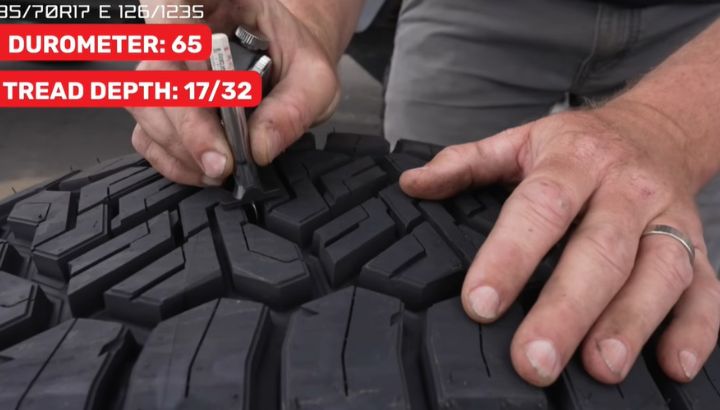
LT means “Light Truck.” It marks tires built for pickups, vans, SUVs, and trailers carrying heavy loads. LT tires use stiffer sidewalls, higher load ratings, and run at 50 to 80 PSI compared to 30 to 35 PSI for passenger tires.
You looked at your truck’s sidewall and saw “LT265/70R17” instead of plain numbers, and now you are wondering whether this matters.
It does. LT is not a marketing letter. It is a load classification that changes how your tire is built, how much air it needs, what it can carry, and what it will cost you when one goes flat. Pickup owners who treat LT tires like passenger tires usually find out the hard way.
What LT Stands For On A Tire Sidewall
LT stands for Light Truck, a service class designation set by the Tire and Rim Association (TRA) and standardized under DOT FMVSS 119 regulations.
Any tire stamped with LT before the size code (e.g., LT245/75R16) is engineered for vehicles that haul or tow heavier loads than typical passenger cars.
LT tires use stiffer sidewalls, deeper tread compounds, and higher ply ratings (Load Range C, D, E, or F) than P-metric tires. They also operate at much higher inflation pressures, typically 50 to 80 PSI compared to 30 to 35 PSI for passenger cars.
You will see LT designations on most full-size pickups (Ford F-250, Chevy Silverado 2500HD, Ram 2500, GMC Sierra HD), commercial vans (Ford Transit, Mercedes Sprinter, Ram ProMaster), and many off-road SUVs (Jeep Wrangler, Ford Bronco, Toyota 4Runner TRD Pro).
The opposite of LT is P-metric (passenger), which prioritizes ride comfort and fuel economy over load capacity.
Where The LT Designation Sits On Your Sidewall
If you do not know how to read your tire size code, the LT letters are easy to miss until something goes wrong. The placement is consistent across every brand.
LT Comes Before The Numbers
The LT designation always appears at the very beginning of the size code, before the section width.
A tire stamped LT275/65R18 123/120R E breaks down as: LT for Light Truck, 275 for section width in millimeters, 65 for aspect ratio, R for radial construction, 18 for rim diameter in inches, 123/120 for load index single/dual, R for speed rating, and E for load range.
If you only see 275/65R18 without the LT prefix, you are looking at a P-metric or Euro-metric tire, not a light truck tire.
Load Range Letter Tells You The Ply Rating
LT tires also carry a load range letter (B through F) that tells you the ply rating and maximum inflation pressure.
Load Range B is 4-ply equivalent at 35 PSI max. Load Range C is 6-ply equivalent at 50 PSI. Load Range D is 8-ply at 65 PSI. Load Range E is 10-ply at 80 PSI. Load Range F is 12-ply at 95 PSI.
Most modern half-ton trucks like the Ford F-150, Chevy Silverado 1500, and Ram 1500 run Load Range C or D. Heavy duty trucks (F-250, Silverado 2500, Ram 2500) typically run Load Range E.
Dual Load Index For Single And Dual Wheel Setups
LT tires often show two load index numbers separated by a slash, like 123/120.
The first number (123) is the load capacity per tire when used in a single-wheel configuration, supporting 3,417 lbs. The second number (120) is per tire in a dual-wheel configuration like a dually pickup, supporting 3,086 lbs.
If you drive a Ford F-450 dually, Ram 3500 dually, or Chevy Silverado 3500HD dually, the second number applies. The lower dual rating accounts for heat and load sharing across paired tires.
DOT, UTQG, And Standards Marks
Like all tires, LT designations include a DOT code (manufacturing date and plant), UTQG ratings (treadwear, traction, temperature), and country of origin.
LT tires are exempt from some UTQG ratings since they are built for utility rather than passenger comfort.
You will see brands like Michelin LTX M/S 2, BFGoodrich All-Terrain T/A KO2, Goodyear Wrangler DuraTrac, Cooper Discoverer AT3, Falken Wildpeak AT3W, Toyo Open Country, Nitto Terra Grappler, and Continental TerrainContact A/T on the LT sidewall along with the size and load designations.
Why LT Tires Are Built Differently From Passenger Tires
The structural differences between LT and P-metric tires affect how your vehicle drives, how much weight it can carry, and what happens when you put the wrong type on the wrong vehicle.
Stiffer Sidewalls For Heavy Loads
LT tires use additional steel belts and reinforced sidewall plies compared to passenger tires.
This stiffness lets them support 3,000 to 4,000 lbs per tire without flexing dangerously, which matters when you are towing a trailer or carrying a half-ton of cargo in the bed.
The trade-off is a stiffer ride. Your Ford F-250 with Load Range E LT tires rides harder than the same truck on P-metric tires, especially unloaded.
Higher Inflation Pressures
LT tires run 50 to 80 PSI compared to 30 to 35 PSI for P-metric.
The higher pressure is required to support the load capacity. Underinflating an LT tire by even 10 PSI dramatically increases heat and blowout risk, especially on highway hauls in summer heat through Texas, Arizona, or Nevada.
You should always set pressure to your door jamb sticker value, not the maximum stamped on the sidewall.
Deeper, More Aggressive Tread Patterns
LT tires often feature deeper tread (15/32 to 19/32 inch new) compared to P-metric (10/32 to 11/32 inch).
The deeper tread is for off-road grip, snow performance, and longer life under heavy use. Brands like BFGoodrich KO2, Goodyear DuraTrac, Falken Wildpeak, and Cooper STT Pro are known for aggressive lug patterns optimized for trucks.
You will trade some highway noise and fuel economy for this capability, but it pays off when you need traction in a quarry, on a job site, or in deep snow.
Reinforced Bead For Higher Pressures
The bead area where LT tires meet the rim is reinforced with extra rubber and bead wire.
This is necessary because the higher inflation pressures (and the heavy loads) put more stress on the bead seal than passenger tires experience.
If you have ever tried to mount an LT tire with a regular passenger tire machine, you know the bead is significantly tougher to break and seat. Shops use heavy-duty equipment like the Hunter TCX59 truck tire changer for LT work.
Reading What The LT Designation Means For Your Vehicle
If your vehicle came with LT tires from the factory, the manufacturer engineered the suspension, brakes, and chassis around them. Substituting passenger tires changes the entire setup.
LT Means Your Truck Was Built To Carry Loads
If your Ford F-250 Super Duty or Chevy Silverado 2500HD has LT tires, your truck is rated for higher gross vehicle weight (GVWR) than a half-ton pickup.
The LT tire is part of how the manufacturer hits that GVWR. Swap to passenger tires, and your effective payload capacity drops significantly.
You will also see this on commercial vans (Ford Transit Connect, Mercedes Sprinter, Nissan NV200) and some heavier SUVs (Toyota Sequoia Platinum, Ford Expedition Max).
LT Tires Affect Your Insurance And Warranty
If your vehicle is rated for LT tires and you replace them with P-metric for a better ride, you may void your warranty on certain components.
Insurance claims after accidents involving overloaded vehicles with the wrong tire type can be denied or reduced.
You should always match the OE service class on your door jamb. If your placard says LT, you fit LT.
LT Tires Affect Speedometer And Drivetrain
LT tires often have slightly different overall diameters than P-metric tires of the same nominal size.
A LT265/70R17 is roughly the same diameter as a P265/70R17, but small differences in load range and construction can cause speedometer drift of 1 to 2 percent.
You will also notice harder shifts on automatic transmissions, since the heavier rotating mass changes acceleration characteristics. This is normal for LT-equipped trucks and vans.
LT Tires Cost More And Wear Differently
LT tires typically cost 20 to 40 percent more than P-metric tires of similar size from the same brand.
Tread life on LT is usually shorter due to softer compounds optimized for grip and load capacity. Most LT all-terrain tires last 40,000 to 60,000 miles, while highway LT tires can hit 60,000 to 70,000 miles.
You should expect higher per-tire costs across the life of an LT-equipped truck.
Making Sure You Buy The Right LT Tire
Before you buy LT tires, run through this checklist. It saves you from fitting the wrong load range or a Euro-metric tire that does not match your truck’s needs.
Step 1: Read Your Door Jamb Sticker
Open your driver door and look at the placard.
The sticker shows OE tire size, load index, speed rating, and inflation pressure. If the OE size starts with LT, you must fit LT.
If your truck came with both LT and P-metric options (some half-ton pickups offer both), the placard tells you which one was installed at the factory.
Step 2: Match The Load Range Or Exceed It
If your OE is LT265/70R17 121/118R E, the replacement must be Load Range E or higher.
Going below the OE load range reduces your effective payload capacity and creates a safety risk under heavy loads.
You can go up to Load Range F if you want extra capacity for heavy hauling, but the tire will run stiffer and may cost more.
Step 3: Confirm Speed Rating
LT tires typically use lower speed ratings than passenger tires.
Common LT speed ratings are Q (99 mph), R (106 mph), S (112 mph), and T (118 mph). You should match or exceed the OE rating for safety and warranty compliance.
If you fit a tire with a lower speed rating, you risk handling instability at highway speeds and may compromise insurance coverage in the event of an accident.
Step 4: Verify Pressure Spec Compatibility
Some LT tires require pressure ranges that your TPMS sensors may not handle accurately.
Most modern Ford, Chevy, GMC, Ram, and Nissan trucks have TPMS calibrated for LT pressure ranges (50 to 80 PSI), but some older or non-truck vehicles do not.
You should confirm with your dealer or shop that the LT tire and your TPMS are compatible before installing.
Step 5: Check For Compatible Tread Type
LT tires come in highway, all-terrain, mud-terrain, and dedicated winter variants.
Highway LT tires (Michelin Defender LTX M/S, Bridgestone Dueler H/L Alenza Plus) are quiet and long-lasting. All-terrain LT (BFGoodrich KO2, Falken Wildpeak AT3W, Cooper Discoverer AT3 4S) balance road and trail. Mud-terrain LT (BFGoodrich KM3, Toyo Open Country MT, Nitto Mud Grappler) are aggressive off-road but loud on highway.
You should match tread type to your driving (90 percent of the time, highway or all-terrain is the right choice).
Symptom To Cause To Fix Diagnostic Table
| Symptom On Your Truck | Likely Cause | Fix |
|---|---|---|
| Sidewall stamped LT275/65R18 | Light Truck designation | Match LT designation when replacing |
| Tire pressure in 50-80 PSI range | LT high-load operating pressure | Set to door jamb spec, not sidewall max |
| Stiff ride on unloaded truck | LT stiffer sidewall | Acceptable under normal hauling, do not lower pressure |
| Reduced fuel economy | LT higher rolling resistance | Trade-off for capacity, choose highway LT for better mileage |
| Faster tread wear than expected | All-terrain or mud-terrain compound | Switch to highway LT for daily driving |
| Speedometer reads 1-2% off | LT and P-metric diameter differences | Verify with GPS, recalibrate if needed |
| TPMS warning at 45 PSI | LT requires higher cold pressure | Inflate to 50 to 80 PSI per door jamb |
| Bead leak at high pressure | Damaged or worn bead from improper mount | Replace tire or have shop reseat bead |
| Tire failure under heavy load | Wrong load range (C instead of E) | Match or exceed OE load range |
| Cupping wear on highway tires | LT all-terrain on smooth pavement | Switch to highway LT or all-season variant |
| One-side wear on dually rear | Pressure imbalance between dual tires | Equalize pressure cold, check valve stems |
| Sluggish acceleration under load | Underinflated LT tires | Check pressure cold, inflate to spec |
How To Spot LT Tires In A Tire Shop Or Online
If you are shopping for tires and need to confirm you are looking at the right type, here are the unmistakable identifiers.
LT Prefix In The Size Code
Every LT tire has the LT prefix at the start of its size code.
You will see it on Tire Rack, Discount Tire, Costco, SimpleTire, and Amazon listings as “LT265/70R17” or “LT245/75R16.”
If the size starts with just numbers (e.g., “265/70R17”), it is a P-metric or Euro-metric tire, not LT.
Higher PSI Stamp On Sidewall
LT tires show maximum cold inflation pressure on the sidewall, typically 50 to 95 PSI depending on load range.
Passenger tires usually show 35 to 44 PSI maximum.
If you see 80 PSI maximum on the sidewall, it is almost certainly an LT or commercial truck tire.
Load Range Letter
LT tires display a load range letter (C, D, E, F) on the sidewall.
Passenger tires use load index numbers (88, 91, 95, etc.) but rarely show a load range letter prominently.
You will see “Load Range E” or simply “E” stamped on the sidewall of LT tires built for heavy duty trucks.
LT-Specific Brand Models
Tire model names often signal the LT designation.
Michelin LTX, Goodyear Wrangler, BFGoodrich KO2 LT, Toyo Open Country LT, and Cooper Discoverer LT all signal Light Truck construction by name.
You will also see commercial-rated models like Continental Vanco and Hankook Vantra LT designed specifically for cargo vans and commercial fleets.
When Switching From LT To P-Metric Or Vice Versa Causes Trouble
There are situations where drivers swap tire classes for the wrong reason. Each one creates a real problem.
LT On A Half-Ton That Came With P-Metric
If you fit LT tires on a half-ton pickup that came with P-metric, you gain payload capacity but lose ride comfort and fuel economy.
The stiffer LT sidewall transmits more road harshness through the suspension, especially when the truck is unloaded.
You will see this on Ford F-150, Chevy Silverado 1500, Ram 1500, and Toyota Tundra owners who upgrade for heavier towing duties. Some report they regret the change and return to P-metric within a year.
P-Metric On A Three-Quarter Ton Or Larger
If you fit P-metric tires on a Ford F-250, Chevy Silverado 2500HD, or Ram 2500, you reduce your truck’s effective payload capacity by 30 to 50 percent.
This is dangerous when towing or hauling heavy loads, since the tires can fail under stress they were never designed to handle.
You should never substitute P-metric for OE LT on a heavy duty truck. Industry standards from USTMA and TIA classify this as an unsafe modification.
Mixing LT And P-Metric On The Same Vehicle
Mixing tire service classes on the same vehicle confuses the ABS, traction control, stability control, and AWD systems.
The different sidewall stiffnesses also create uneven wear patterns and unpredictable cornering behavior.
You should always run four matching tires of the same service class, brand, and size. If you replace just two LT tires, the other two should also be LT, not P-metric.
Using LT On Passenger Cars
If you fit LT tires on a passenger car or crossover, the ride will be unbearably stiff, and the higher rolling resistance will hurt fuel economy and acceleration.
You will also stress the suspension components designed for lighter, softer tires, leading to premature wear of bushings, shocks, and struts.
LT tires belong on trucks, vans, and heavy SUVs. They are not for daily commuter sedans.
LT Tire Comparison By Use Case
| Tire Type | Load Range | Best For Your Truck If | Example Brands | Approx Lifespan |
|---|---|---|---|---|
| Highway LT | C or D | You drive mostly paved roads and tow occasionally | Michelin Defender LTX M/S, Bridgestone Dueler H/L Alenza Plus | 60,000 to 70,000 mi |
| All-terrain LT | C, D, or E | You split between road and trail | BFGoodrich KO2, Falken Wildpeak AT3W, Cooper Discoverer AT3 4S | 40,000 to 60,000 mi |
| Mud-terrain LT | E or F | You run heavy off-road | BFGoodrich KM3, Toyo Open Country MT, Nitto Mud Grappler | 30,000 to 50,000 mi |
| Heavy hauler LT | E or F | You tow heavy trailers regularly | Goodyear Wrangler DuraTrac, Continental TerrainContact H/T | 50,000 to 60,000 mi |
| Commercial van LT | C or D | You drive Sprinter, Transit, ProMaster | Continental Vanco 4Season, Michelin Agilis | 50,000 to 60,000 mi |
| Winter LT | C, D, or E | You face snow and ice in winter | Bridgestone Blizzak DM-V2, Michelin LTX Winter | 30,000 to 40,000 mi |
| All-season LT | C, D, or E | You want one tire for the year | Cooper Discoverer AT3 4S, Goodyear Wrangler All-Terrain Adventure | 50,000 to 65,000 mi |
| Dually rear LT | E or F | You drive a one-ton dually | Michelin XPS Rib, Goodyear Wrangler HT | 60,000 to 80,000 mi |
Tools Worth Owning For LT Tire Care
Pick up a digital tire pressure gauge rated to at least 100 PSI like the Milton S-921 pencil gauge (rated to 120 PSI) or JACO ElitePro (rated to 100 PSI).
A Viair 88P portable inflator handles up to 120 PSI for LT pressure ranges.
A torque wrench calibrated to 120 to 140 ft-lbs for full-size truck lugs (compared to 80 to 100 ft-lbs for cars).
Keep a Slime tire repair kit with longer plugs designed for LT thicker tread, and an OBD2 scanner like the Autel TS508 to handle TPMS resets that involve higher pressure thresholds.
Why Drivers Misunderstand LT Tires
These misconceptions cost truck owners thousands every year. Avoid them and your LT setup performs as designed.
Treating LT Pressure Like Passenger Pressure
If you set LT tires to 32 PSI like a sedan, you will overheat them within hours of highway driving.
LT tires need their door jamb pressure (50 to 80 PSI depending on the truck) to support the load.
You should check pressure cold once a month using a high-PSI gauge, not a regular passenger gauge that maxes out at 60 PSI.
Buying Mud-Terrain LT For Daily Highway Driving
Mud-terrain LT tires (BFGoodrich KM3, Toyo Open Country MT, Nitto Mud Grappler) are loud, wear fast on pavement, and reduce fuel economy by 5 to 10 percent.
If you spend 90 percent of your driving on highways, fit highway LT or all-terrain LT instead.
You will save $300 to $600 per tire set in tread life and another $500 to $1,000 in fuel over the life of the tires.
Mixing Load Ranges Across Axles
If you put Load Range E LT tires on the rear and Load Range C on the front, you create uneven sidewall stiffness that affects steering, braking, and stability.
Always match the load range across all four tires on a single-rear-wheel truck.
For dually pickups, the rear tires share the load between two paired wheels, but they should still match each other within the pair.
Ignoring The Difference Between LT And C Type
Some Euro-metric and commercial tires use a C designation at the end (e.g., 225/75R16C) instead of the LT prefix.
These C-type tires are common on European-built vans and light commercial vehicles like the Mercedes Sprinter and Ford Transit.
You should not assume C-type and LT are interchangeable. Confirm with your owner’s manual or dealer before swapping.
Skipping Wheel Spec Verification
LT tires often need wheels with higher load ratings than passenger wheels.
If you fit LT tires on aftermarket wheels rated for passenger use only, you risk wheel failure under load.
You should confirm wheel load rating before any LT tire install, especially when running aftermarket alloys.
How To Get The Most Life From Your LT Tires
If you maintain LT tires correctly, they deliver every mile they were designed for.
Set Pressure Cold And Re-Check Monthly
Check pressure cold (before driving or 3 hours after parking) every month.
LT tires lose pressure faster than passenger tires due to their higher operating pressure. Use a high-PSI gauge and adjust to door jamb spec.
Pressure changes about 1 PSI per 10°F temperature swing, so winter and summer adjustments are mandatory.
Rotate Every 5,000 To 7,500 Miles
LT tires wear faster on the front of trucks (especially 4WD with weight on the front axle).
Rotate following your owner’s manual pattern (forward cross for 4WD, X-pattern for RWD) every 5,000 to 7,500 miles.
Pair rotation with engine oil changes (Mobil 1, Castrol Edge, Pennzoil Platinum, Shell Rotella) to make the schedule automatic.
Annual Alignment And Suspension Check
Heavy duty trucks beat up their suspension faster than passenger cars.
Get an annual alignment using a shop with a Hunter HawkEye Elite machine. Inspect ball joints, tie rods, and bushings during each oil change.
Worn suspension components cause uneven LT tire wear that no rotation schedule can fix.
Real Life Scenario
You drive a 2020 Ford F-250 Super Duty with original LT275/65R20E Goodyear Wrangler All-Terrain tires.
After 55,000 miles of mixed highway and worksite use, you check your tread depth and find 5/32 inch remaining on the front and 6/32 inch on the rear (your rotation discipline kept things even).
You shop for replacements and confirm your truck calls for Load Range E with a 121/118R load index.
You buy four BFGoodrich KO2 LT275/65R20E at $310 each from Tire Rack with shipping to a Discount Tire installer.
Mounting and balancing runs $30 per tire, plus new valve cores at $4 each, plus TPMS reset at $0 (Discount Tire includes it). Total: $1,376.
You check pressure cold to 65 PSI front, 70 PSI rear per the door jamb, drive home, and have an alignment done within the week. Your new tires should hit 50,000 miles before replacement, and your truck handles the same loads it always did.
Frequently Asked Questions
What Does The LT On My Tire Sidewall Mean?
LT stands for Light Truck, a service class designation indicating the tire is built for vehicles that haul or tow heavier loads than passenger cars.
LT tires use stiffer sidewalls, deeper tread compounds, and higher ply ratings (Load Range C, D, E, or F) than P-metric tires.
They also operate at higher inflation pressures, typically 50 to 80 PSI compared to 30 to 35 PSI for passenger cars.
You will see LT designations on most full-size pickups, heavy duty trucks, commercial vans, and many off-road SUVs. The LT prefix is set by industry standards from the Tire and Rim Association (TRA) and DOT FMVSS 119 regulations.
Are LT Tires Better Than P Tires?
LT and P-metric tires are not “better” or “worse.” They are designed for different vehicles and uses.
LT tires excel at carrying heavy loads, towing trailers, and handling rough terrain due to their reinforced sidewalls and higher load ratings.
P-metric tires excel at ride comfort, fuel economy, and quiet highway performance because of their softer construction.
You should always match the OE service class on your door jamb. Putting LT on a sedan ruins the ride. Putting P-metric on a heavy duty truck reduces payload capacity by 30 to 50 percent and creates safety risks.
Can I Use LT Tires Instead Of P Tires On My Truck?
Sometimes. If your half-ton pickup (Ford F-150, Chevy Silverado 1500, Ram 1500) came with P-metric tires from the factory, you can switch to LT for heavier towing duties.
You will gain load capacity but lose some ride comfort and fuel economy.
If your truck is a heavy duty model (F-250, Silverado 2500HD, Ram 2500) that came with LT, you must stay with LT. Switching to P-metric reduces payload capacity dangerously.
You should always check your door jamb sticker and owner’s manual before any service class change. Some manufacturers explicitly approve both options for half-ton trucks.
What PSI Should LT Tires Be Inflated To?
LT tires typically run 50 to 80 PSI depending on load range and vehicle.
Load Range C tops out at 50 PSI. Load Range D at 65 PSI. Load Range E at 80 PSI. Load Range F at 95 PSI.
The exact pressure for your truck is on the driver door jamb sticker, not the sidewall maximum.
You should inflate cold (before driving) and adjust based on load. Towing or carrying heavy cargo may require pressures near the maximum, while empty driving allows lower pressures within the manufacturer-recommended range.
Do LT Tires Last Longer Than P-Metric Tires?
Not necessarily. LT tire lifespan depends on tread type and use.
Highway LT tires like the Michelin Defender LTX M/S and Bridgestone Dueler H/L Alenza Plus can last 60,000 to 70,000 miles with good rotation discipline.
All-terrain LT tires like the BFGoodrich KO2 typically last 40,000 to 60,000 miles. Mud-terrain LT tires last 30,000 to 50,000 miles.
Premium P-metric touring tires like the Michelin Defender 2 can last 70,000 to 80,000 miles, comparable to or longer than highway LT options. The right comparison depends on the specific tire model, not the service class alone.
What Is The Difference Between LT And C Type Tires?
Both LT and C-type tires are designed for higher loads than passenger tires, but they use different size code formats.
LT tires (Light Truck) use the LT prefix at the start of the size code, like LT275/65R18.
C-type tires use a C suffix at the end, like 225/75R16C, and are common on European commercial vans and light commercial vehicles like the Mercedes Sprinter and Ford Transit.
You should not assume LT and C-type are interchangeable. Confirm with your owner’s manual or dealer before swapping. Some vehicles can use either, but most are engineered for one specific format.
Why Do LT Tires Cost More Than Regular Tires?
LT tires use more materials, stiffer construction, deeper tread, and reinforced beads compared to passenger tires.
The manufacturing process is more complex, and quality control standards are higher to meet load range certifications under DOT FMVSS 119.
Premium LT tires from Michelin, BFGoodrich, Goodyear, Continental, and Toyo typically run 20 to 40 percent more than P-metric tires of similar size.
You should expect to pay $200 to $400 per tire for quality LT options on full-size trucks, plus mounting, balancing, and TPMS service. The added cost reflects the additional engineering and durability.
Can LT Tires Be Used On A Sedan Or SUV?
LT tires are not appropriate for sedans or most crossover SUVs.
The stiffer sidewalls transmit road harshness through the suspension, ruining ride comfort. The higher rolling resistance hurts fuel economy and acceleration.
LT tires also stress passenger car suspension components designed for lighter, softer tires, leading to premature wear of shocks, struts, and bushings.
You should only fit LT tires on vehicles rated for them: full-size pickups, heavy SUVs (Toyota Sequoia, Ford Expedition, Chevy Tahoe in some configurations), and commercial vans. Crossovers like the Toyota RAV4, Honda CR-V, or Mazda CX-5 should always run P-metric or all-season passenger tires.
Are LT Tires Required For Towing?
LT tires are not always legally required for towing, but they are strongly recommended for any serious tow vehicle.
If your truck came from the factory with LT tires, you should keep LT tires for towing. The reinforced sidewalls and higher load ratings handle the dynamic loads of trailer braking, swaying, and weight transfer that passenger tires cannot.
If your truck has P-metric tires from the factory, you may still be within manufacturer specs for light towing (under 5,000 lbs).
You should check your truck’s tow rating, your trailer’s weight, and your tire’s load index before any major tow. Underrated tires under heavy trailer loads cause blowouts that can wreck the truck, the trailer, and the cargo all at once.
Conclusion
The LT prefix on your sidewall is not decorative. It is a service class that tells you the tire was built for heavier loads, higher pressures, and rougher work than a passenger tire was ever designed to handle.
If your Ford F-250, Chevy Silverado 2500HD, Ram 2500, or commercial van came with LT tires, you replace them with LT tires. If you tow, haul, or drive off-road regularly, you choose LT for the load capacity and durability it provides.
If you mostly commute and your half-ton truck came with P-metric, you can stay with P-metric for the smoother ride and better fuel economy without giving up daily-driving capability.
A truck does not become a truck because of the badge on the tailgate. It earns the title at the rim, where the sidewall meets the road, and where every pound of cargo eventually rests.