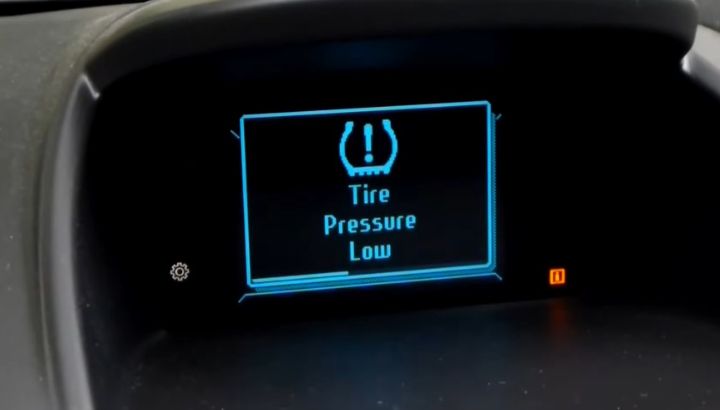
Inflate all four tires plus spare to door jamb PSI. Drive 10 to 20 minutes above 25 mph for auto reset. If light stays on, hold the TPMS reset button under the steering wheel until it blinks three times.
If your tire pressure light stays on after you fill your tires, your TPMS system needs a manual reset or your sensor is failing.
In the next few minutes, you will learn exactly how to reset your tire pressure light, when to suspect a dead sensor, and how to avoid paying a shop for a 5 minute job.
What Is The Tire Pressure Light?
Your tire pressure light is a yellow horseshoe-shaped icon with an exclamation mark inside, sometimes labeled TPMS on newer vehicles.
It is the visual output of your Tire Pressure Monitoring System, a federally mandated safety feature on every passenger vehicle sold in the US after September 2007 under the NHTSA TREAD Act.
The light has one job: warn you when any tire drops 25 percent below the recommended cold inflation pressure printed on your driver door jamb.
If your spec is 32 PSI, your light triggers near 24 PSI, well before the tire becomes visibly flat to your eye.
Your TPMS works in two main configurations. Direct TPMS uses a small battery-powered sensor mounted inside each wheel, broadcasting pressure data on 315 MHz or 433 MHz radio frequency to your vehicle’s receiver module.
Indirect TPMS uses your existing ABS wheel speed sensors to detect a tire spinning faster than the others, since an underinflated tire has a smaller diameter and rotates more times per mile.
Most US vehicles use direct TPMS for accuracy, while many European cars and base trims use indirect systems.
The light has three behaviors you need to recognize. A solid yellow light means low pressure in one or more tires.
A flashing light for 60 to 90 seconds at startup means a sensor fault, dead battery, or communication failure.
A light that comes on cold mornings and clears as tires warm up means a temperature-induced pressure drop, normal in winter and easily fixed by topping up to spec.
Symptoms You Will Notice With Your Tire Pressure Light
Your tire pressure light is more than a yellow icon on your dash. It tells you something specific about your TPMS (Tire Pressure Monitoring System), and the way it behaves points to the exact problem.
If you read your light correctly, you fix it in minutes instead of guessing.
Solid Yellow TPMS Light On Your Dash
If your tire pressure light glows steady yellow, one or more tires are below the placard PSI by 25 percent or more, per NHTSA TREAD Act rules.
The light shape is a horseshoe with an exclamation mark inside, sometimes labeled TPMS on newer vehicles like your Toyota, Ford, or Honda.
You should pull over safely, check pressure on all four tires plus your spare with a digital tire pressure gauge, and inflate to the value on your door jamb sticker.
Flashing TPMS Light For 60 To 90 Seconds
If your light flashes for 60 to 90 seconds at startup and then stays solid, you have a sensor fault, not a low pressure event.
This means one of your TPMS sensors has a dead battery, a damaged antenna, or has lost communication with your vehicle’s ECU.
In this case, no amount of inflation fixes the light. You need a sensor scan with an OBD2 scanner or TPMS relearn tool to identify the failed unit.
Light That Returns Every Cold Morning
If your TPMS light appears in the morning and disappears after 20 minutes of driving, you have a temperature-related pressure drop.
Pressure falls about 1 PSI per 10°F drop, so a 30°F overnight swing easily triggers the warning.
You fix this by topping up to spec when tires are cold and ignoring the brief morning light if pressure is correct, though chronic cycling means a slow leak.
Light Stays On After You Inflated Your Tires
If you already filled your tires to the correct PSI and your light refuses to clear, your system needs a manual reset or relearn procedure.
Some vehicles auto-reset after a short drive. Others require a button press, an OBD2 scan tool, or magnet-and-valve sensor relearn.
The procedure depends on your make, model, and year, which you will see in the diagnostic section below.
What Your Tire Pressure Light Actually Means
Your TPMS does not just measure pressure. It runs a self-check, talks to four sensors, and decides whether to alert you.
If you understand the chain, you fix the right thing the first time.
Direct TPMS Versus Indirect TPMS
Direct TPMS uses a battery-powered sensor inside each wheel that broadcasts pressure data on 315 MHz or 433 MHz to your vehicle’s receiver.
Indirect TPMS uses your ABS wheel speed sensors to detect a tire spinning faster than the others, which means it is smaller and therefore underinflated.
Most vehicles built after 2007 in the US use direct TPMS by federal mandate, while many European cars and base trims use indirect systems that require manual recalibration.
Sensor Battery Life And Failure Modes
Your TPMS sensor has a sealed lithium battery that lasts 5 to 10 years depending on driving frequency and climate.
Once the battery dies, the sensor stops broadcasting, and your dash flashes the TPMS light. You cannot replace the battery alone because the sensor is sealed.
Common failure brands you will encounter include Schrader, VDO, Continental, and Huf, which are OE on most vehicles, while aftermarket programmable units come from Autel, Dorman, and Orange Electronic.
Trigger Threshold And Reset Logic
Your TPMS triggers when any tire drops 25 percent below the cold inflation pressure listed on your door jamb, typically 30 to 35 PSI for passenger cars.
Once you correct the pressure, your vehicle either auto-resets after 10 to 20 minutes of driving above 25 mph, or it requires a manual relearn depending on the make.
If neither method works, you have a sensor fault that needs scanning, not a pressure issue.
Identify The Exact Cause Before You Reset
Before you press any buttons or attempt a reset, confirm what is actually wrong.
If you skip this step, you risk masking a real leak or a failing sensor.
Step 1: Check Pressure On All Five Tires
Use a quality digital pressure gauge like the JACO ElitePro or Accutire MS-4021B and read each tire when cold, meaning before you drive or at least 3 hours after parking.
Match every reading to the door jamb sticker value, not the maximum PSI stamped on the sidewall.
Do not forget your spare. Many full size and even some compact spares have TPMS sensors that trigger the light when low.
Step 2: Look For Visible Damage Or Leaks
Inspect each tire sidewall and tread for nails, screws, cracks, or bulges that explain a slow leak.
Spray a soapy water mixture around the valve stem and bead area; bubbles indicate a leak that no reset will fix.
If you find damage, you repair or replace the tire before resetting the light, otherwise the warning will return within hours.
Step 3: Read The TPMS Trouble Code
Plug an OBD2 scanner like the Autel TS508, BlueDriver, or Innova 5610 into your OBD2 port under the dash to read TPMS DTCs (diagnostic trouble codes).
Common codes include C0750 (LF sensor fault), C0755 (RF sensor fault), and B2725 (sensor not communicating).
If a code points to a specific wheel, you have a failed sensor, not a pressure issue, and the reset procedure will fail until you replace it.
Step 4: Check Battery Voltage On Your Vehicle
A weak vehicle battery below 12.4 volts can corrupt your TPMS module memory and create false warnings.
Test your battery with a multimeter or load tester such as the Schumacher BT-100 before assuming the issue is in the tires.
If your battery is failing, address that first and then attempt the TPMS reset, which often clears automatically.
Symptom To Cause To Fix Diagnostic Table
| Symptom | Likely Cause | Fix |
|---|---|---|
| Solid yellow TPMS light | One tire below 25% of placard PSI | Inflate all tires to door jamb spec |
| Flashing TPMS light 60-90 sec | Sensor fault or dead battery | Scan OBD2, replace failed sensor |
| Light returns every cold morning | Temperature pressure drop | Inflate to spec when cold |
| Light on after inflating | System needs manual reset | Press TPMS reset button or relearn |
| Light on with new tires | Sensor not relearned | Perform relearn with TPMS tool |
| Light on after rotation | Sensor positions not updated | Relearn positions with scan tool |
| Light flickers intermittently | Failing sensor or weak signal | Replace sensor with Autel MX-Sensor |
| Light stays on after spare use | Spare tire sensor low | Inflate or remove spare from system |
| Light on with TPMS code C0750 | Left front sensor failure | Replace LF sensor, relearn |
| Light on after wheel swap | Wrong frequency sensors | Match 315 MHz or 433 MHz to vehicle |
| Light on, all PSI correct | Vehicle battery weak (under 12.4V) | Test and replace battery |
| Light on, no codes present | TPMS module fault | Reset or replace module |
Step By Step Reset Procedure By Method
The right reset method depends on your vehicle make and model.
If you choose the wrong one, your light stays on and you waste time.
Tools You Will Need
You need a digital tire pressure gauge, air compressor like the Viair 88P or EPAuto 12V, the door jamb PSI value, and your owner’s manual.
For sensor faults, you also need an OBD2 TPMS scan tool such as the Autel MaxiTPMS TS601, Foxwell NT530, or ATEQ VT56.
A multimeter helps verify battery voltage. A basic socket set is needed if you replace sensors yourself.
Method 1: Auto Reset By Driving
Inflate all four tires plus the spare to the door jamb PSI when cold.
Drive your vehicle at speeds above 25 mph for 10 to 20 minutes continuously, allowing each sensor to broadcast its updated reading to your TPMS receiver.
This method works on most Honda, Toyota, Nissan, and many newer Ford vehicles. If your light goes out during the drive, you are done.
Method 2: TPMS Reset Button Procedure
Locate the TPMS reset button, usually under your steering wheel, inside the glove box, or on the lower dash console near the OBD2 port.
Turn your ignition to ON without starting the engine, press and hold the TPMS reset button until your dash light blinks three times, then release.
Start the engine and let it idle for 20 minutes. The system relearns sensor IDs and clears the warning automatically.
Method 3: OBD2 Scan Tool Relearn
Plug your TPMS-capable OBD2 scanner into the diagnostic port under your dash.
Select your make, model, and year, then choose TPMS Relearn or Sensor ID Write from the menu, follow on-screen prompts to activate each sensor with the magnetic wand or trigger tool.
This method is required on most BMW, Mercedes-Benz, Audi, and Lexus vehicles, and on any car after a wheel swap or sensor replacement.
Method 4: Magnet Or Tire Deflation Relearn
Some older vehicles like 2003 to 2010 GM trucks use a deflation-based relearn.
Turn ignition to ON, hold the lock and unlock buttons on the key fob simultaneously until the horn chirps, then deflate each tire in sequence (LF, RF, RR, LR) until the horn chirps again to confirm each sensor.
Reinflate to spec, drive briefly, and the light clears.
When Your Reset Will Not Work
If you tried the reset and the light is still on, you have a deeper issue that no button press will fix.
You must diagnose before throwing more time at it.
Failed TPMS Sensor
If a sensor battery is dead, no reset works. Your scan tool will show no signal from that wheel position.
Replacement sensors cost $30 to $80 each from brands like Autel MX-Sensor, Dill, or Schrader EZ-Sensor, and require dismounting the tire to install.
After replacement, you must perform a relearn so your vehicle pairs the new sensor ID to the correct wheel position.
Wrong Frequency Or Incompatible Sensor
If you bought used wheels with sensors that broadcast on the wrong frequency, your vehicle will not see them.
North American vehicles mostly use 315 MHz while European and some Asian vehicles use 433 MHz.
Verify the frequency for your VIN before installing aftermarket sensors. Programmable units from Autel and Bartec cover both bands.
Damaged Receiver Or TPMS Module
If your TPMS receiver module fails, no sensor in the world will help.
Symptoms include all four wheels showing as faulty simultaneously, the light staying on regardless of pressure, and OBD2 communication errors with the TPMS module.
Replacement modules cost $200 to $600 plus programming, and the work is best done at a dealer or specialty shop.
Aftermarket Wheels Without Sensors
If you swapped to aftermarket wheels without TPMS sensors installed, your light will never go off.
Some drivers install TPMS bypass emulators to silence the warning, though this is illegal in most states under federal motor vehicle safety standards.
The legal fix is to install proper sensors in your aftermarket wheels and perform a relearn.
Best Tools And Scan Tool Comparison
Choosing your right TPMS tool saves you time and money.
A cheap tool that does not support your make leaves you stuck at the dealer paying triple.
| Tool | Features | Vehicle Coverage | Best For You If | Approx Cost |
|---|---|---|---|---|
| Autel MaxiTPMS TS508 | Full relearn, sensor programming | Most makes 1996+ | You service multiple cars | $300 to $400 |
| Autel MaxiTPMS TS601 | Diagnostic + relearn + activation | 90% of makes | You want pro-level coverage | $400 to $550 |
| ATEQ VT56 | Pro-grade activation, programming | Almost all makes | You run a shop | $700 to $1100 |
| Foxwell NT530 | OBD2 + TPMS for specific brands | BMW, Mercedes, Toyota | You own one make long-term | $200 to $300 |
| BlueDriver Bluetooth | OBD2 codes only, limited TPMS | All OBD2 vehicles | You want a basic reader | $100 to $130 |
| Innova 5610 | OBD2 + ABS + TPMS basic | Most US vehicles | You DIY occasionally | $250 to $350 |
| Bartec Tech400SD | Pro relearn and clone | Nearly all makes | You want fleet-grade tool | $700 to $1000 |
Pressure Gauges And Inflators You Should Own
Pick up a JACO ElitePro digital gauge or Milton S-921 pencil gauge for accurate readings.
Get a Viair 88P portable compressor or EPAuto 12V inflator to fill tires at home or roadside.
A Slime tire repair kit covers small puncture emergencies. A basic torque wrench like the Tekton 24335 ensures lug nuts are tightened properly after any wheel work.
Mistakes That Make The TPMS Light Worse
If you make these mistakes, you turn a 5 minute fix into a multi-hour headache.
Avoid them and your reset succeeds the first try.
Inflating To Sidewall Maximum Instead Of Door Jamb
The PSI on your tire sidewall is the maximum cold pressure, not the recommended.
Always use the door jamb sticker value, typically 32 to 35 PSI for passenger cars, higher for trucks and SUVs.
If you inflate to the sidewall max, you reduce contact patch and create false wear, even if the light goes off temporarily.
Skipping The Spare Tire
Many vehicles monitor a fifth sensor in the spare tire. If your spare is low, the light stays on no matter how perfect your road tires are.
Check your spare every time you address a TPMS warning, especially on full size spares in trucks and SUVs.
If your vehicle does not monitor the spare, you can skip this, but it is good practice to keep it inflated to 60 PSI for emergency use.
Replacing Sensors Without Relearning
If you install new sensors but do not perform a relearn, your vehicle does not know which sensor is at which wheel.
The light will stay on or come back within minutes of driving. Always relearn after sensor replacement, tire rotation on certain models, or wheel swaps.
Most modern Toyota, Honda, and Ford vehicles auto-relearn after driving, but BMW, Audi, and Mercedes require an OBD2 tool.
Using A Bypass Or Disable Module
If you install a TPMS emulator to silence the light, you violate federal safety regulations and lose a critical safety system.
Real low pressure events go undetected, increasing blowout and crash risk.
The correct fix is always to address the root cause, whether that is a leak, a dead sensor, or a needed relearn.
How To Prevent Recurring TPMS Warnings
If you set up a simple maintenance loop, your TPMS light stays off for years.
Skip these steps and you will see the light constantly.
Monthly Cold Pressure Checks
Check your tire pressure cold once a month using a quality digital gauge.
Adjust to door jamb PSI, accounting for the 1 PSI per 10°F rule when temperatures shift.
Mark a calendar reminder so you do not forget. This single habit prevents 80 percent of TPMS warnings entirely.
Sensor Replacement During Tire Changes
When you replace tires, replace the TPMS sensor service kits at minimum, and consider replacing the entire sensor if it is older than 7 years.
Service kits cost $3 to $8 per wheel and include the valve core, valve cap, grommet, and nut, all of which corrode over time.
If you skip this, you create slow leaks at the valve that trigger your light over and over.
Annual TPMS Health Scan
Once a year, scan your TPMS with an OBD2 tool to read sensor battery voltages and signal strength.
Sensors near end of life often work fine until they fail completely, which always happens at the worst time.
Proactively replacing weak sensors saves you from roadside surprises and dealer markups.
Real Life Scenario
You drive a 2018 Honda CR-V and your TPMS light came on yesterday morning during a cold snap.
You checked all four tires and found they read 28 PSI, while the door jamb sticker calls for 33 PSI.
You inflated all four to 33 PSI, drove for 15 minutes on the highway, and the light cleared automatically.
The next morning the light returned, so you suspected a slow leak. You sprayed soapy water around each valve stem and found bubbles at the right rear.
You replaced the valve core with a $2 part from your local AutoZone, reinflated, drove 10 minutes, and the light stayed off.
Total cost: $2 and 30 minutes. A shop would have charged $80 plus labor for the same job.
Frequently Asked Questions
Why Is Your Tire Pressure Light Still On After Filling Tires?
If your tire pressure light remains on after you inflated all four tires plus the spare to door jamb spec, your TPMS system needs to relearn the new pressure values.
Some vehicles auto-reset after 10 to 20 minutes of driving above 25 mph, while others require you to press a TPMS reset button under the steering wheel until the dash light blinks three times.
If neither method works after a full drive cycle, you likely have a failed sensor, a slow leak you missed, or a low spare tire that you forgot to check.
How Long Does It Take For The TPMS Light To Reset?
Auto reset typically takes 10 to 20 minutes of continuous driving above 25 mph, giving each sensor enough cycles to broadcast its updated pressure reading to your vehicle’s receiver.
Manual reset using the TPMS button is instant once you complete the procedure, though you may need to drive a short distance to verify the fix.
OBD2 tool relearns take 5 to 15 minutes depending on the tool and your vehicle’s specific protocol.
If your light is not clearing within 30 minutes of driving after correct inflation, you have a sensor or system fault that requires diagnosis.
Can You Reset The Tire Pressure Light Without A Scan Tool?
Yes, on most Honda, Toyota, Nissan, Subaru, and many Ford vehicles you can reset without a scan tool.
Inflate all tires to the correct PSI, then either drive 20 minutes above 25 mph or hold the TPMS reset button until your dash blinks confirmation.
European vehicles like BMW, Mercedes, Audi, and many luxury models require an OBD2 TPMS tool because their direct sensor systems do not auto-relearn after pressure changes.
If your owner’s manual lists a specific procedure, follow it exactly. Otherwise, try the drive method first since it costs nothing and works on most cars.
Where Is The TPMS Reset Button Located On Your Vehicle?
The TPMS reset button is typically under the steering wheel on the lower dash, inside the glove box, in the center console, or near the OBD2 port.
On most Honda models you find it on the lower left dash. On many Toyota vehicles it is mounted under the steering column. Nissan often places it inside the glove box on the right side panel.
Check your owner’s manual for the exact location, since not every vehicle has a button. If your car does not have one, you must use the auto-drive method or an OBD2 tool to reset.
How Much Does It Cost To Replace A TPMS Sensor?
Sensor replacement costs $30 to $80 per sensor for the part, plus $25 to $50 in labor per wheel because the tire must come off the rim.
A complete four-sensor replacement at a tire shop typically runs $200 to $400 total, including new valve cores, grommets, and a relearn procedure.
Programmable aftermarket sensors from Autel MX-Sensor or Continental REDI-Sensor save money over OE parts for older vehicles.
If you DIY the install with a tire machine or pre-mounted wheels, you save the labor cost but still need an OBD2 tool to perform the relearn correctly.
What Pressure Should Your Tires Be For The TPMS Light To Stay Off?
Your tires must be at or above the cold inflation pressure listed on your driver door jamb sticker, typically 30 to 35 PSI for passenger cars and 35 to 45 PSI for trucks and SUVs.
The TPMS triggers when pressure drops 25 percent below this value. So if your spec is 32 PSI, the light triggers around 24 PSI.
Always inflate when tires are cold, meaning before you drive or at least 3 hours after parking, since hot tires read 3 to 5 PSI higher and give a false correct reading.
Will A Bad Battery Affect The TPMS Light?
Yes, a weak vehicle battery below 12.4 volts can cause your TPMS module to behave erratically.
Symptoms include the light coming on randomly, all four sensors reporting faults at once, or the light staying on despite correct pressure and good sensors.
Test your battery with a multimeter when the engine is off, and load test it if voltage is borderline.
Replacement batteries from brands like Interstate, Optima, DieHard, or Bosch restore proper TPMS function. Many drivers chase phantom TPMS issues for weeks before realizing the actual problem is a dying battery.
Does Tire Rotation Affect The TPMS Light?
On many vehicles tire rotation does affect the TPMS, since the system tracks which sensor is at which wheel position by ID.
After rotation, your front-left sensor is now at rear-right, and the system may flag this as a fault until you perform a relearn.
Some newer Ford, Chrysler, and GM vehicles auto-relearn during a drive cycle, while BMW, Mercedes, and Audi require an OBD2 tool.
Honda and Toyota usually do not require a relearn after rotation since they only monitor low pressure events without tracking specific positions. Always check your manual after rotation if the light comes on unexpectedly.
Is It Safe To Drive With The TPMS Light On?
It is not safe to drive long distances with a solid TPMS light on without first checking your pressure, since the light means at least one tire is significantly underinflated.
Underinflated tires generate excessive heat, increase blowout risk, reduce fuel economy by 3 to 5 percent, and dramatically extend braking distance.
If your light is flashing for 60 to 90 seconds at startup, you have a sensor fault rather than a pressure issue, and short trips are safe while you arrange repair.
In either case, check pressure on all five tires immediately and address whatever caused the warning before continuing your drive.
Conclusion
You should reset your tire pressure light by first inflating all four tires plus your spare to the door jamb PSI, then driving 10 to 20 minutes above 25 mph for an auto-reset.
If your light remains on, hold your TPMS reset button until your dash blinks three times, or use an OBD2 scan tool for vehicles that require manual relearn.
If neither method works, scan for trouble codes to identify a failed sensor, a weak vehicle battery, or a slow leak that no reset will mask.
My final expert tip for you: keep a digital pressure gauge and a portable inflator in your trunk, check pressure cold once a month, and you will rarely see your TPMS light again.