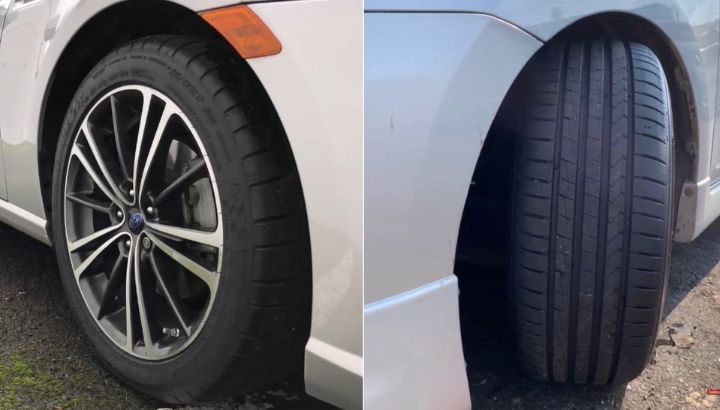
Sometimes yes, sometimes no. A 45 series tire is shorter than a 50 series, dropping overall diameter by about 3 to 5 percent. If your speedometer error stays under 3 percent and the tire clears your fenders, you can run it. Otherwise, stick to OE.
You found a deal on tires marked 225/45R17 but your car calls for 225/50R17.
The numbers look close, the price tag looks closer, and the question is whether one digit really matters. It does. That single number changes your sidewall height, ride comfort, speedometer reading, and whether your TPMS throws a fit on the way home.
What Is The Aspect Ratio Difference Between 45 And 50
The number after the slash on your sidewall (the aspect ratio) is the sidewall height as a percentage of the tire’s section width.
A 225/50R17 tire has a sidewall that is 50 percent of 225 mm, which equals 112.5 mm of sidewall height.
A 225/45R17 tire has a sidewall that is 45 percent of 225 mm, which equals 101.25 mm of sidewall height. That is 11.25 mm shorter per side, or roughly 22.5 mm (0.89 inch) smaller in overall diameter.
This shorter sidewall changes how the tire flexes, how it absorbs bumps, how the speedometer calibrates, and how the tire fits inside your wheel well. It is not a free swap, but it is not always a deal-breaker either.
The acceptable swap rule, set by the Tire and Rim Association (TRA) and ETRTO standards, is to stay within 3 percent of original overall diameter.
Symptoms You Will Notice After Switching From 50 To 45
If you fit a 45 series tire when your vehicle calls for 50, your car tells you within the first 50 miles of driving.
The clues are mechanical, electronic, and physical, and ignoring them costs you in tire wear and dashboard warnings.
Speedometer Reads Higher Than Actual Speed
If you switch from 225/50R17 to 225/45R17, your tire’s overall diameter shrinks by roughly 3 percent.
That means your speedometer now reads about 3 percent fast, so when you see 60 mph on the dash, your GPS shows roughly 58 mph.
Your odometer also under-reports mileage, which affects warranty mileage tracking, lease return calculations, and any mileage-based maintenance reminders programmed into your vehicle’s ECU.
Stiffer, Harsher Ride Quality
The shorter sidewall has less rubber to flex over bumps, potholes, and expansion joints.
You will feel sharper impacts through the steering wheel, seat, and floor pan, especially on rough roads or in cold weather when rubber stiffens further.
This matters more on family sedans and crossovers (Toyota Camry, Honda Accord, Subaru Outback) than on already-firm sport sedans.
Improved Steering Response And Cornering Grip
A 45 series tire has less sidewall flex, which means quicker turn-in and sharper feedback from the front wheels.
If you drive a sporty car like a BMW 3 Series, Mazda 3, Volkswagen GTI, or Honda Civic Si, you may actually like the change.
The trade-off is comfort for handling, and that is a personal preference, not a safety issue, as long as the diameter math checks out.
Increased Risk Of Wheel Damage
A shorter sidewall provides less cushion between the road and your alloy wheel.
If you hit a pothole at speed, the impact reaches the rim faster and harder, raising the risk of bent or cracked rims.
You will see this most clearly on aftermarket low-profile setups in regions with rough roads, like the Northeast US in winter.
TPMS Or Speedometer Calibration Warnings
Some vehicles, especially Tesla, Audi, BMW, and Mercedes-Benz, use indirect TPMS that compares wheel speeds.
A 3 percent diameter change can confuse the system, triggering a TPMS warning or ABS code that does not clear with a simple reset.
In rare cases, you may need to recalibrate the speedometer at a dealer or with a tool like the Autel MaxiSys to get the system back in spec.
What These Symptoms Mean For Your Tire Decision
Each symptom traces back to one of two issues: changed overall diameter or changed sidewall stiffness. Reading them right tells you whether the swap is worth doing.
A 3 Percent Diameter Drop Is The Hard Limit
The 3 percent rule is not arbitrary. It is the threshold above which your speedometer becomes legally inaccurate, your odometer mileage tracking fails, and your transmission shift points may misfire on automatic vehicles.
A 225/50R17 has an overall diameter of about 25.86 inches.
A 225/45R17 has an overall diameter of about 24.97 inches.
The difference is 0.89 inches, or 3.4 percent, which is just over the safe limit. That puts this swap on the borderline of “technically wrong” for most vehicles.
Tire Width Matters As Much As Aspect Ratio
If you keep section width the same (225 in both cases), only the sidewall height changes.
If you also change width (e.g., 235/45R17 instead of 225/50R17), the math changes. A 235/45R17 has a diameter of 25.32 inches, which is only 2.1 percent smaller than 225/50R17 and falls within the safe range.
This is why tire calculators are mandatory before any swap. The combination of width and aspect ratio determines whether the new tire is safe.
Load Index And Speed Rating Must Match Or Exceed OE
A lower aspect ratio tire often has a different load index because the smaller air volume affects load capacity.
If your OE is 225/50R17 94H (load index 94 = 1,477 lbs, speed rating H = 130 mph), the replacement must be 94H or higher.
If you fit 225/45R17 91W, the load index drops below OE (91 = 1,356 lbs), which compromises safety especially when carrying passengers or cargo. Always read the sidewall before buying.
Wheel Width Compatibility
Each tire size has a recommended rim width range measured in inches.
A 225/50R17 typically fits a 6.0 to 8.0 inch wide rim. A 225/45R17 typically fits a 7.0 to 8.5 inch wide rim.
If your factory rim is 6.5 inches wide, fitting a 45 series tire stretches the sidewall and can cause uneven wear, poor seal, or bead failure.
Identify Whether The Swap Is Safe For Your Vehicle
Before you commit, run through this checklist. It takes 10 minutes and saves you a return trip to the tire shop.
Step 1: Read Your Door Jamb Sticker
Open your driver door and look at the placard for the OE tire size, load index, and speed rating.
The placard is your authoritative spec. The owner’s manual confirms it.
If the placard says 225/50R17 94V, you must match or exceed those values, including the W or higher speed rating if you drive a performance vehicle.
Step 2: Use A Tire Size Calculator
Plug both sizes into a calculator like the Tire Rack Tire Size Comparison, 1010Tires.com calculator, or Discount Tire’s online tool.
The calculator shows overall diameter, circumference, revolutions per mile, sidewall height, and percentage difference.
If the percentage difference exceeds 3 percent, the swap is not safe for daily driving without compensating with a different width or wheel diameter.
Step 3: Check Your Wheel Width Specification
Look at the inside of your wheel hub or the original sticker for the rim width in inches.
Cross-reference against the tire’s recommended rim range, listed on the manufacturer’s website (Michelin, Continental, Bridgestone, Pirelli, Goodyear, Hankook, Yokohama).
If your rim falls outside the recommended range, you risk tire failure, bead leak, or sidewall damage.
Step 4: Verify Speed Rating And Load Index
Read the load index and speed rating on the new tire.
Compare to your OE spec. The new tire must match or exceed both values.
A common mistake is finding a great deal on a lower-spec tire and assuming the difference does not matter. It does, especially in high-speed cornering, summer heat, or full passenger loads.
Step 5: Confirm Wheel Well Clearance
Even if the math works, physically check that the new tire clears your fender wells and suspension components.
Turn the wheel lock-to-lock with the new tire installed. Look for rubbing on inner fender liners, struts, brake calipers, or CV axles.
If you hear scraping or feel binding, the tire is not viable.
Symptom To Cause To Fix Diagnostic Table
| Symptom | Likely Cause | Fix |
|---|---|---|
| Speedometer reads 3-5% high | Overall diameter dropped from sizing change | Stay within 3% diameter or recalibrate |
| Harsh ride over bumps | Shorter sidewall provides less cushion | Stay with 50 series or upgrade shocks |
| TPMS warning after install | Indirect TPMS confused by diameter | Reset TPMS or use OE size |
| Tire rubs at full lock turn | Shoulder catches inner fender | Return to OE size or trim liner |
| Vibration at highway speed | Out-of-balance from new wheel match | Rebalance with road force balance |
| Bent rim after pothole | Reduced sidewall cushion on impact | Avoid potholes or fit OE size |
| Premature shoulder wear | Improper rim width match | Verify rim width range, replace tire |
| Sluggish steering response | Going from 45 to 50 (opposite direction) | Match tire family to driving style |
| ABS or stability control warning | Diameter mismatch confusing wheel speed sensors | Restore OE size or recalibrate ECU |
| Failed state inspection | Speedometer reads outside legal tolerance | Restore OE size before inspection |
| Increased road noise | Aggressive tread pattern on 45 series | Choose touring 45 model like Pilot Sport AS |
| Faster tread wear | Performance compound on commute use | Switch to all-season 45 series like Continental DWS06 |
Step By Step Process To Make A Safe Aspect Ratio Change
If you absolutely want to change from 50 to 45, here is the only way to do it without compromising safety or legality.
Tools You Will Need
You need a digital tire pressure gauge like the JACO ElitePro or Accutire MS-4021B, an OBD2 scanner like the BlueDriver or Autel TS508 for TPMS resets, and a tread depth gauge to verify the new tires arrive fresh.
A torque wrench calibrated to 80 to 100 ft-lbs ensures lugs go on right.
Step 1: Compensate Width Or Wheel Diameter
The cleanest way to drop from 50 to 45 is to also increase tire width or rim diameter.
For example, 225/50R17 has a 25.86-inch diameter. Going to 245/45R17 gives you 25.68 inches, only 0.7 percent smaller, well within tolerance.
You can also go to 225/45R18 (diameter 26.0 inches), which is 0.5 percent larger but uses a larger wheel diameter, a process called plus-sizing.
Step 2: Verify Your Wheel Width Supports The New Size
If you increase tire width to 245, your existing rim must be at least 7.5 inches wide.
If your rim is the standard 7-inch width that came with 225/50R17, you cannot safely fit a 245 tire without buying new wheels.
This is where many DIY size changes go wrong. The tire might mount, but the sidewall geometry is incorrect.
Step 3: Order The Right Tires And Verify The DOT Date
When the new tires arrive, check the DOT code on the sidewall.
The last four digits show week and year of manufacture. A code of 0824 means the 8th week of 2024.
Refuse any tire with a DOT code older than 12 months unless heavily discounted. Old stock loses tread compound flexibility, especially in performance summer tires.
Step 4: Have A Qualified Shop Mount And Balance
Take the new tires to a reputable shop like Discount Tire, Tire Rack installer network, Costco Tire Center, or Les Schwab.
Request road force balancing for premium results, which costs $15 to $25 more per wheel but eliminates vibration on cars sensitive to imbalance.
Confirm the shop torques lug nuts to spec (typically 80 to 100 ft-lbs) using a calibrated torque wrench, not an impact gun set to maximum.
Step 5: Reset TPMS And Recheck Specs
After installation, reset your TPMS sensor with a tool like the Autel TS508 or drive 10 to 20 minutes above 25 mph for auto-relearn on most Honda, Toyota, and Ford vehicles.
European vehicles like BMW, Mercedes, and Audi often require an OBD2 TPMS tool for proper relearn.
Drive a 30-mile test loop and verify your speedometer matches GPS within 3 percent, your TPMS stays off, and you do not feel rubbing in turns.
When This Swap Will Not Work
Some vehicles, conditions, and use cases make a 50-to-45 swap a non-starter. Here is when to walk away.
Vehicles With Indirect TPMS Or Tight Tolerances
Tesla Model 3, Tesla Model Y, BMW M models, and most Audi RS and Mercedes AMG vehicles have very tight tire size tolerances tied to ABS, stability control, and driver-assist features.
Going outside the OE size, even by 3 percent, can disable adaptive cruise control, lane-keep assist, or trigger persistent dashboard warnings.
If you drive any of these, fit OE specs only or go through the dealer for a vehicle-specific size change.
AWD Vehicles With Mismatched Tread Depths
If you fit two 45 series tires on the front and leave 50 series tires on the rear (or vice versa), your AWD differential and viscous coupling will work overtime.
The diameter mismatch creates constant slip, leading to transfer case damage that can cost $2,000 to $5,000 to repair.
Always run all four tires the same size on AWD vehicles like Subaru Outback, Audi Quattro, and BMW xDrive models.
Cars With Speedometer Calibration Locked To OE
Some manufacturers lock speedometer calibration to the OE tire size in the ECU.
Going to a 3 percent smaller tire will cause your dash to read incorrectly with no software fix available without a dealer recalibration.
This is common on Tesla, late-model Ford F-150, Ram 1500, and Chevy Silverado trucks. Verify recalibration availability before changing sizes.
Lease Or Warranty Vehicles
If your vehicle is leased, changing from OE size violates most lease agreements and can result in fees at lease return.
If your vehicle is under warranty, fitting non-OE sizes can void coverage on suspension, drivetrain, and electronic stability components.
Read your lease or warranty paperwork before any size change, and document the swap with the dealer if you proceed.
Tire Size Comparison Table
| OE Size | Alternative Size | Diameter Change | Speedometer Error | Safe To Use |
|---|---|---|---|---|
| 225/50R17 | 225/45R17 | -3.4% | +3.5% | Borderline, not recommended |
| 225/50R17 | 235/45R17 | -2.1% | +2.1% | Safe with proper rim |
| 225/50R17 | 245/45R17 | -0.7% | +0.7% | Safe with 7.5 inch rim |
| 225/50R17 | 225/45R18 | +0.5% | -0.5% | Safe (plus-size) |
| 225/50R17 | 215/55R17 | +1.0% | -1.0% | Safe |
| 225/50R17 | 235/50R17 | +1.6% | -1.6% | Safe |
| 215/45R17 | 225/45R17 | +1.4% | -1.4% | Safe |
| 235/45R18 | 245/40R18 | -1.5% | +1.5% | Safe |
| 245/45R18 | 255/40R18 | -2.5% | +2.5% | Borderline |
| 215/50R17 | 215/45R18 | +0.7% | -0.7% | Safe (plus-size) |
Tools And Resources You Should Use
Pick up a Milton S-921 pencil gauge for backup roadside checks and a JACO ElitePro digital gauge for accuracy.
Use the Tire Rack tire size calculator at tirerack.com or the 1010tires.com size comparison before any swap.
Keep a Viair 88P portable inflator in the trunk for roadside corrections, and a Slime tire repair kit for emergencies.
Mistakes That Make This Swap Dangerous
If you make these mistakes, what should be a budget tire purchase turns into a safety, legal, or financial liability.
Buying By Price Without Running The Math
The cheapest tire on the wall is not always the right tire for your vehicle.
A $95 225/45R17 may seem like a steal compared to a $140 225/50R17, but if the swap puts your speedometer outside legal tolerance, the savings disappear in tickets and recalibration fees.
Always run the size through a calculator and compare overall diameter before buying based on price alone.
Ignoring Load Index Or Speed Rating Drop
A common trap is fitting a 45 series tire with a lower load index or speed rating than OE.
Going from 94H to 91W drops capacity from 1,477 lbs to 1,356 lbs per tire, a difference that matters when carrying passengers, cargo, or towing.
Always match or exceed OE load index and speed rating, regardless of size change.
Mixing 45 And 50 On The Same Vehicle
Putting two 45 series tires on the front and two 50 series on the rear (or vice versa) creates uneven handling, false ABS readings, and AWD drivetrain damage.
Always run four matching tires of the same size, brand, model, and tread depth.
If you must replace just two tires temporarily, fit them on the rear axle for stability and aim to replace all four within 5,000 miles.
Skipping Wheel Alignment After Install
A new tire size changes the loaded ride height of the vehicle slightly, which can affect alignment.
Fitting new tires without an alignment guarantees uneven wear and can damage the new rubber within 10,000 miles.
The cost of a four-wheel alignment is $80 to $150 and pays for itself in tire life.
Trusting Tire Shop Staff Without Verification
Not every tire shop employee runs the math on your specific vehicle.
Some will fit whatever you ordered without checking load index, speed rating, or diameter compatibility.
You should bring your door jamb spec on your phone and verify the new size against it before agreeing to installation. Trust but verify.
How To Avoid Future Tire Size Confusion
If you build the habit of checking specs every time, you avoid 95 percent of bad tire purchases.
The routine takes minutes and saves hundreds of dollars and dashboard headaches.
Always Use The Door Jamb As Your Authoritative Source
The placard on your driver door jamb is the single source of truth for tire size, load index, speed rating, and inflation pressure.
The owner’s manual confirms it, but the placard is always current with the vehicle as built.
If a previous owner or shop changed tire sizes, the placard still tells you what the manufacturer engineered the vehicle to use.
Run Every Potential Swap Through A Tire Calculator
Free online tools at Tire Rack, 1010Tires, Discount Tire, and SimpleTire make size comparison easy.
Enter your OE size and the proposed new size, and the calculator displays diameter difference, speedometer error, sidewall height change, and rim width compatibility in seconds.
Make this a habit before any tire purchase, even when the difference looks small on paper.
Stick With OE Unless You Have A Specific Reason To Change
If you are not chasing performance gains, plus-sizing for aesthetics, or solving an availability problem, the OE size is almost always the best choice.
Engineers selected the OE size to match the vehicle’s suspension geometry, gearing, fuel economy targets, and stability control calibration.
Changing for the sake of change rarely improves anything and often creates new problems.
Real Life Scenario
You drive a 2019 Honda Civic Sport with factory 235/40R18 tires. The car needs new tires, and the shop offers you 235/45R18 at a discount.
You should refuse this swap. The 235/45R18 has a diameter of 26.34 inches versus your OE 235/40R18 at 25.41 inches. That is a 3.7 percent increase, just over the safe threshold.
Your speedometer would read about 3.7 percent slow, and your TPMS could throw a fit because the Civic uses indirect monitoring tied to ABS wheel speed.
Instead, you find Continental ExtremeContact DWS06 Plus in 235/40R18 94Y for $200 each at Tire Rack, get them shipped to a partner installer, pay $80 for mounting and balance, $20 for new valve stems, and $0 for TPMS reset because you reset it yourself with an Autel TS508.
You drive home with a tire that matches the OE engineering exactly, and your dash stays clear.
Total cost: $900 for four tires installed and balanced. Total saved by not chasing a “deal” on the wrong size: untold hours of frustration and a possible ECU recalibration fee.
Frequently Asked Questions
Can I Use 45 Series Tires Instead Of 50 Series Tires?
Sometimes, but rarely without compensating elsewhere. A direct swap from 225/50R17 to 225/45R17 changes your overall diameter by 3.4 percent, which exceeds the safe 3 percent threshold set by tire industry standards.
This causes speedometer error, harsh ride, and TPMS issues on vehicles with indirect monitoring.
The cleaner approach is to widen the tire (235/45R17 or 245/45R17) or step up the wheel diameter (225/45R18) to keep total rolling diameter close to OE. Always check with a tire size calculator before buying.
Will A Lower Aspect Ratio Tire Affect My Speedometer?
Yes. A lower aspect ratio tire has a smaller overall diameter, so each rotation covers less ground.
The wheel speed sensors that feed your speedometer assume the OE tire diameter, which means your dash now reads higher than your actual speed.
If you go from 50 to 45 series at the same width and rim diameter, expect a 3 to 4 percent speedometer error, which puts you outside legal tolerance in many regions.
You can fix this by increasing tire width or rim diameter to keep total diameter within 3 percent of OE.
Is It Safe To Drive On Tires With A Different Aspect Ratio?
Safe within limits, dangerous outside them.
If your replacement tire keeps the overall diameter within 3 percent of OE and matches or exceeds load index and speed rating, the swap is safe for daily driving.
Outside that range, you risk speedometer errors, TPMS warnings, drivetrain damage on AWD, and reduced safety in emergency maneuvers.
You should run any size change through a tire calculator like Tire Rack’s tool, verify wheel width compatibility, and confirm your specific vehicle does not have tight tolerances tied to electronic stability or driver-assist systems.
Will A 45 Series Tire Ride Rougher Than A 50 Series?
Yes. The shorter sidewall in a 45 series tire has less rubber to absorb bumps, so impacts transmit more directly to your steering wheel, seat, and floor pan.
The difference is most noticeable on rough roads, expansion joints, and cold weather when rubber stiffens.
You will gain sharper steering response and better cornering grip in exchange for the harsher ride.
If your vehicle is a comfort-focused sedan or crossover, this trade-off may not be worth it. If it is a sport sedan or hot hatch, you may actually prefer the 45 series feel.
Can I Mix 45 And 50 Series Tires On My Car?
No, you should not mix aspect ratios across axles or even on the same axle.
Different tire diameters create false ABS readings, confuse stability control, and on AWD vehicles can damage the transfer case, differential, and viscous coupling.
Always run four matching tires of the same size, brand, model, and tread depth.
If you must replace just two tires temporarily, put the new ones on the rear axle for stability and plan to replace all four within 5,000 miles to maintain handling balance and electronic system integrity.
Will My Tire Pressure Light Come On With A Different Size?
It can, especially on vehicles with indirect TPMS that compares wheel rotation speeds.
A 3 percent diameter change creates a constant rotational speed difference that the system may interpret as a flat tire.
On direct TPMS vehicles (most US-market cars after 2007), the sensor still reads pressure correctly, but you may need to relearn sensor positions after installation.
You can reset most systems with an OBD2 TPMS tool like the Autel TS508, Innova 5610, or by driving 10 to 20 minutes above 25 mph for auto-relearn on Honda, Toyota, and Ford models.
Does A Lower Profile Tire Wear Out Faster?
Often yes. Most 45 series tires are designed for sportier applications and use softer compounds for grip, which wears faster than touring tire compounds.
A typical 45 series performance tire lasts 20,000 to 40,000 miles, while a 50 series touring tire lasts 50,000 to 70,000 miles.
You can extend life by choosing all-season 45 series options like Continental ExtremeContact DWS06 Plus, Michelin Pilot Sport All Season 4, or Bridgestone Potenza Sport AS, which balance grip with reasonable tread life.
Performance summer tires like Michelin Pilot Sport 4S wear fastest of all.
Are 45 Series Tires More Expensive Than 50 Series?
Usually slightly more, but not always.
Performance and ultra-high-performance 45 series tires from premium brands like Michelin Pilot Sport 4S, Bridgestone Potenza S001, and Pirelli P Zero run $200 to $400 per tire.
Touring and grand-touring 50 series tires from the same brands run $130 to $230 per tire.
Budget brands like Falken, Hankook, Kumho, and Yokohama offer competitive pricing in both aspect ratios. The price difference reflects compound technology and intended use, not just sidewall height.
Will Insurance Cover Damage From The Wrong Tire Size?
Maybe, depending on the insurer and the situation.
If your accident is caused by a tire failure that traces back to using a non-OE size with mismatched load or speed rating, your claim may be denied or reduced.
If the tire size change is documented and within manufacturer-approved alternatives (matching load index, speed rating, and diameter within tolerance), most insurers will cover the claim normally.
You should keep records of any tire size change, the shop that installed it, and the OE specs you matched. Talk to your insurance agent before making non-OE changes if you are concerned about coverage.
Conclusion
Going from a 50 series to a 45 series tire at the same width and rim diameter changes your overall diameter by about 3.4 percent, which is just past the safe limit set by tire industry standards.
The clean way to make the swap work is to compensate elsewhere: widen the tire (235 or 245), step up the rim diameter (18-inch instead of 17), or accept that the OE size is the right call.
You always need to match or exceed load index and speed rating, verify wheel width compatibility, run the math through a tire calculator, and confirm your vehicle’s TPMS and electronic stability systems handle the new size.
A tire is the only thing between your car and the road. The math is not optional.