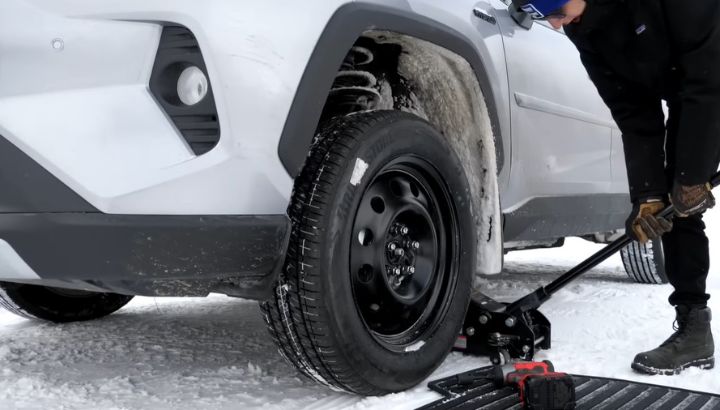
All season tires handle light snow on flat roads but struggle with deep snow, ice, and steep grades. They lose 30 to 50 percent of their grip below 7°C (45°F). For real winter driving, dedicated winter tires with the 3PMSF symbol outperform them by a wide margin.
If you are asking are all season tires good in snow, the marketing on the sidewall is one answer and the road below 32°F is another.
The “M+S” stamp lets manufacturers sell them as winter-capable, but the rubber compound tells the real story when the temperature drops. Drivers in Boston, Chicago, Denver, and Minneapolis figure this out in their first January. The ones in Atlanta or Sacramento usually never need to.
What All Season Tires Are Engineered To Do
All season tires are designed to deliver acceptable performance across dry pavement, wet roads, and light snow conditions in moderate climates.
The compound is a compromise: harder than a dedicated winter tire (which would melt in summer heat) and softer than a dedicated summer tire (which would crack in winter cold).
Most all-seasons carry the M+S (Mud and Snow) marking, which is a self-certified label from the Rubber Manufacturers Association (RMA) indicating the tread pattern has the geometric capability for light snow traction.
A smaller subset of all-seasons (often called all-weather tires) also carry the 3PMSF symbol (three-peak mountain snowflake), which certifies severe snow performance under standardized ASTM F1572 testing.
When you ask are all season tires good in snow, you are really asking whether the M+S compound and tread design can handle your specific winter conditions. The answer depends on temperature, snow depth, ice presence, and how steep the roads are between your house and your job.
What Happens To All Season Tires When Temperatures Drop
The cold transforms all season tires in ways most drivers never see directly. Knowing the chemistry helps you predict performance before you find out the hard way.
Compound Hardening Below 45°F
The rubber compound in all season tires loses flexibility below 7°C (45°F).
The tread surface stiffens, which reduces the tire’s ability to conform to road imperfections and microscopic surface texture. Grip drops by 30 to 50 percent at freezing temperatures.
You will feel this as longer braking distances, slower acceleration, and reduced cornering grip even on dry pavement when temperatures hit the 30s.
Tread Block Squirm In Deep Snow
All season tread patterns have larger, fewer sipes (small slits cut into the tread) than dedicated winter tires.
Deep snow needs many small biting edges to grip. The relatively smooth all-season tread packs with snow quickly and loses traction.
You should expect significant slipping in snow deeper than 2 to 3 inches, especially when starting from a stop or climbing grades.
Ice Performance Is The Worst Case
Ice is where all season tires truly fail.
The compound stiffness combined with the lack of dense siping means the tire cannot conform to or grip ice surfaces. Stopping distances on ice can extend 2 to 3 times longer than on dry pavement.
You should treat any iced-over road as a critical condition where all-seasons may not be enough, regardless of brand or price.
Cold Pressure Drop
All season tires lose 1 PSI per 10°F temperature drop.
A vehicle parked overnight in a New England December morning may show 5 to 10 PSI lower pressure than its door jamb specification.
You will see your TPMS light come on more frequently in winter, and underinflated tires perform even worse on snow and ice than they would at correct pressure.
Aged All Seasons Get Worse Faster
If your all-season tires are over 3 to 4 years old, the compound has already begun hardening from oxidation.
Add winter cold to age-related stiffening, and grip drops further than on a fresh all-season tire.
You should never run aged all-seasons through a full winter in cold climates. Replace at the 4 to 5 year mark before the second or third winter on the same set if you live where temperatures stay below freezing for weeks at a time.
What Drivers Notice On The Road With All Seasons In Snow
Real-world driving reveals all season limitations long before any test track measures them. Knowing the patterns helps you stop blaming yourself when the tires are the issue.
Slipping When Starting From A Stop
If you press the throttle gently on a snow-covered street and your wheels still spin, your all-seasons cannot grip the snow.
This is most obvious on slight inclines, even 2 to 3 percent grades that you would never notice in summer.
You should give the throttle the lightest possible touch and let the traction control system manage power delivery. Even with traction control, you may struggle.
Sliding Through Stop Signs Or Red Lights
If your stopping distance has visibly extended on snow, your tires are losing braking grip before you can react.
A typical all-season can extend snow braking distance by 30 to 80 feet compared to a dedicated winter tire from 70 mph to 0.
You should leave 3 to 4 times more following distance than in summer, and brake earlier than instinct tells you.
Steering Goes Light Or Floats
If your steering wheel feels disconnected from the road, your front tires are losing lateral grip on the snow surface.
This is common during turns, lane changes, and highway speed transitions in heavy snow.
You should slow down significantly and avoid sudden steering inputs. The vehicle’s electronic stability control will help, but it cannot create grip that does not exist.
Wheel Hop Or Studder On Hills
If you climb a snowy hill and the wheels chatter or hop without forward progress, your tires are spinning faster than the road can grip them.
This is the most dangerous all-season failure because you can lose forward momentum and start sliding backward.
You should never attempt steep grades on snow with worn or aged all-seasons. Even fresh ones struggle on grades above 6 percent with snow accumulation.
TPMS Warnings Increasing In Frequency
If your TPMS light comes on every cold morning during winter, your tire pressure is dropping below 25 percent of door jamb spec.
This combination of underinflation and cold compound hardening creates the worst possible all-season grip on snow.
You should adjust pressure cold every 2 weeks during winter, accounting for the 1 PSI per 10°F rule and any specific pressure recommendations on your driver door jamb.
What Each Snow Condition Asks Of Your Tires
Not all snow is the same, and not all winters are the same. Knowing what your conditions actually demand tells you whether all-seasons are enough or whether you need dedicated winter rubber.
Light Snow On Flat Roads
If your winter consists of occasional 1 to 2 inch snowfalls on flat city streets, all season tires from premium brands like Michelin CrossClimate 2, Continental TerrainContact A/T, or Bridgestone Turanza QuietTrack can handle the conditions adequately.
The combination of M+S marking, modern compounds, and proper inflation gets you through most light winter days.
You will still want to drive carefully, but you do not necessarily need dedicated winter tires.
Heavy Snow Or Sustained Cold Below 20°F
If your area sees 6 plus inches of snow at a time, sustained temperatures below 20°F (-7°C), or weeks of below-freezing days, all season tires are insufficient.
The compound is too hard at these temperatures to provide acceptable grip.
You should fit dedicated winter tires from October to April. Brands like Bridgestone Blizzak, Michelin X-Ice Snow, Nokian Hakkapeliitta, Continental WinterContact TS 850 P, Goodyear UltraGrip Performance, and Pirelli Winter Sottozero provide significantly better cold-weather performance.
Ice And Freezing Rain
If your winter includes freezing rain, ice storms, or persistent ice on roads, no all-season tire is adequate.
Even premium 3PMSF-rated all-weathers struggle on glare ice.
You should fit studless winter tires (or studded if legal in your state) for ice conditions. Brands like Bridgestone Blizzak DM-V2, Michelin X-Ice Snow, and Nokian Hakkapeliitta R5 are designed specifically for ice grip.
Steep Grades In Mountainous Areas
If you drive through Colorado, Utah, Wyoming, Montana, Idaho, Vermont, New Hampshire, or other mountainous states with grades above 6 percent, all season tires create real safety risks.
The combination of cold, snow, and incline overwhelms all-season grip capability.
You should fit dedicated winter tires for any winter driving in mountain states. Many ski areas legally require 3PMSF tires or chains during certain conditions.
Mixed Conditions Across A Single Day
If your daily commute crosses from cold mountain passes to warmer valley roads, you face a tougher challenge than pure winter driving.
All season tires handle the warmer parts but struggle with the cold mountain sections.
You should consider all-weather tires (3PMSF rated) like Michelin CrossClimate 2 as a middle-ground option. They handle mixed conditions better than standard all-seasons while avoiding the summer wear of dedicated winter tires.
Symptom To Cause To Fix Diagnostic Table
| Symptom On Snow | Likely Cause | Fix |
|---|---|---|
| Wheels spin from a stop on flat snow | All-season compound too hard for cold | Fit dedicated winter tires or 3PMSF all-weather |
| Sliding through stop signs | Reduced braking grip on cold compound | Slow down, leave more space, consider winter tires |
| Light steering feel in turns | Lateral grip loss on snow | Slow down, smooth inputs, fit winter tires for severe conditions |
| Wheel hop on inclines | Insufficient bite on slope | Fit winter tires or 3PMSF all-weather |
| TPMS warning every cold morning | Pressure dropped from temperature change | Inflate to door jamb spec, accept seasonal pressure variation |
| Cannot stop on ice | Compound stiffness on glare ice | Fit dedicated studless or studded winter tires |
| Cupping wear on all-seasons | Worn shocks plus winter use | Replace shocks (Bilstein, KYB, Monroe), then tires |
| Tread depth below 4/32 inch | Wear plus aging compound | Replace tires before winter |
| Tires older than 6 years | Rubber hardened beyond compound spec | Replace regardless of tread |
| Loss of grip below 20°F | Sustained cold beyond all-season range | Fit winter tires from October to April |
| Hydroplaning on slush | Tread cannot evacuate water-snow mix | Maintain at least 5/32 inch tread, reduce speed |
| Slipping when accelerating uphill | Inadequate grip for grade | Stop, back down, try lower speed; fit winter tires for repeat |
How To Decide If All Season Tires Work For Your Climate
Before you commit to all-seasons or dedicated winter rubber, run through this assessment. It takes 5 minutes and saves you from making the wrong winter tire decision.
Step 1: Check Your Average Winter Temperature
Look up the average low temperature for your area in December, January, and February.
If averages stay above 45°F, all-seasons handle the climate fine. If averages stay between 20°F and 45°F, all-seasons are usable but compromised. Below 20°F sustained, dedicated winter tires are mandatory for safety.
You can use NOAA Climate Data Online or Weather.gov historical data for accurate averages in your area.
Step 2: Count Your Annual Snowfall
If your area gets less than 5 inches of snow per year (think Atlanta, Charlotte, Nashville, Sacramento, Phoenix), all-seasons are sufficient.
If your area gets 5 to 30 inches annually (think Indianapolis, Kansas City, Pittsburgh, St. Louis), all-weather tires (3PMSF rated) are a solid upgrade.
If your area gets 30 plus inches annually (think Buffalo, Boston, Denver, Minneapolis, Cleveland, Detroit, Chicago, Salt Lake City), dedicated winter tires deliver significant safety benefits.
Step 3: Evaluate Your Roads And Routes
If your daily driving stays on plowed city streets and main roads, all-seasons may be adequate.
If your routes include unplowed side streets, rural roads, or mountain grades, dedicated winter tires are important.
You should also consider hill steepness. Grades above 6 percent combined with snow create conditions that exceed all-season capability regardless of brand.
Step 4: Assess Your Driving Habits And Vehicle
If you drive cautiously, work from home, can stay off roads during storms, and have AWD with stability control, all-seasons may stretch through more conditions than for an aggressive driver in a RWD sports car.
If you commute long distances, drive in all weather, and need predictable grip, dedicated winter tires earn their cost.
You should also consider the vehicle. AWD helps with acceleration but does nothing for braking and cornering, where winter tires make the biggest difference.
Step 5: Calculate Total Cost Across The Tire Lifecycle
A set of dedicated winter tires plus dedicated winter wheels costs $800 to $1,800 upfront.
The trade-off: your all-seasons last longer (no winter wear) and your winter tires last longer (no summer wear). Over 5 to 7 years, the total cost often equals running one set of all-seasons that gets replaced every 50,000 to 60,000 miles.
You should run the math for your situation. Many drivers find that dedicated tire sets cost the same as single-set ownership while delivering significantly better year-round safety.
Tire Type Comparison Table For Winter Conditions
| Tire Type | Snow Performance | Ice Performance | Best For You If | Example Brands | Approx Lifespan |
|---|---|---|---|---|---|
| Standard all-season (M+S) | Light snow only | Poor | You live in warm or moderate climates | Michelin Defender 2, Goodyear Assurance ComforTred | 60,000 to 80,000 mi |
| Performance all-season | Limited snow | Poor | You drive sport sedans in mild winters | Michelin Pilot Sport All Season 4, Continental ExtremeContact DWS06 Plus | 40,000 to 60,000 mi |
| All-weather (3PMSF) | Moderate snow | Fair | You see real but not severe winters | Michelin CrossClimate 2, Continental AllSeasonContact 2 | 60,000 to 70,000 mi |
| Studless winter | Excellent | Good to excellent | You face full winter conditions | Bridgestone Blizzak DM-V2, Michelin X-Ice Snow | 30,000 to 40,000 mi |
| Studded winter | Excellent | Best on ice | You drive on ice frequently | Nokian Hakkapeliitta R5 with studs, Continental IceContact 3 | 30,000 to 40,000 mi |
| Performance winter | Good snow, fair ice | Fair | You drive sport sedans in winter | Pirelli Sottozero 3, Michelin Pilot Alpin 5 | 25,000 to 35,000 mi |
| Light truck winter | Good snow, good ice | Good | You drive a truck or SUV in winter | Bridgestone Blizzak DM-V2 LT, Cooper Discoverer Snow Claw | 30,000 to 40,000 mi |
| Highway commercial winter | Good for fleets | Good | You drive a van or commercial vehicle | Continental Vanco 4Season, Goodyear Cargo G91 | 50,000 to 60,000 mi |
Tools And Supplies Worth Owning For Winter Driving
Pick up a digital tire pressure gauge like the JACO ElitePro or Accutire MS-4021B for monthly pressure checks year-round.
A Viair 88P portable inflator lets you correct pressure during cold snaps. A Slime tire repair kit covers small puncture emergencies, and a Tekton 24335 torque wrench ensures lug nuts go to spec when swapping seasonal tire sets.
A simple OBD2 scanner like the BlueDriver or Innova 5610 verifies TPMS reset after any tire service.
Where Winter Tire Investment Makes Sense Versus Where It Does Not
Not every driver needs to spend on dedicated winter tires. Knowing the threshold helps you spend smart.
When Winter Tires Pay Back
If you live in a climate with sustained cold below 20°F, regular snowfall, or icy roads, dedicated winter tires deliver real safety benefits that justify the cost.
The $400 to $1,200 for a set plus another $400 to $800 for dedicated wheels (so you swap rather than dismount/remount) typically pays back within 3 to 5 winters through avoided accidents, faster commutes during storms, and longer all-season life.
You should consider winter tires mandatory if you live in Buffalo, Boston, Detroit, Cleveland, Chicago, Minneapolis, Denver, Salt Lake City, Anchorage, or similar climates.
When All-Weather Tires Are The Smart Middle Ground
If your winters include some snow but not severe ice or mountain driving, all-weather tires with the 3PMSF symbol provide a practical compromise.
Brands like Michelin CrossClimate 2, Continental AllSeasonContact 2, Vredestein Quatrac Pro, Goodyear Assurance WeatherReady, and Bridgestone Weatherpeak balance year-round performance with real winter capability.
You will pay $20 to $40 more per tire than a standard all-season but avoid the cost and complexity of swapping seasonal sets.
When All-Seasons Are Sufficient
If you live in Atlanta, Charlotte, Dallas, Phoenix, Sacramento, San Diego, Houston, Tampa, or similar mild climates, standard all-seasons handle your conditions adequately.
The extreme cases (occasional ice storms, surprise snowfall) may catch you out, but the cost-benefit math rarely supports dedicated winter tires.
You should keep all-seasons fresh (replaced at 5 to 6 years maximum) and accept that during rare severe weather, staying home is the right call.
When You Should Not Cheap Out On Tires
If you drive performance vehicles, AWD vehicles in winter conditions, or commercial vehicles, the cost of premium tires is not optional.
Performance vehicles with V or W speed ratings need matching winter tires (Pirelli Sottozero 3, Michelin Pilot Alpin 5) to maintain their handling characteristics.
AWD vehicles benefit dramatically from winter tires because the AWD system helps with acceleration but cannot help with braking or cornering, where winter tires shine.
Questions That Need Honest Answers
Before deciding, ask yourself: Do I drive in conditions that exceed what my current tires handle confidently? Have I had near-misses or accidents that better tires might have prevented? Am I avoiding driving during storms because I do not trust my tires?
Honest answers to these questions tell you whether all-seasons are working or whether you need to upgrade.
Mistakes Drivers Make With All Season Tires In Winter
Five common mistakes turn marginal winter performance into actual danger. Avoid these and your all-seasons deliver their full (limited) capability.
Driving On Worn All Seasons Through Winter
If your tread depth has dropped below 5/32 inch, your all-seasons cannot effectively channel snow and water away from the contact patch.
Many drivers run tires until the legal 2/32 inch minimum, but winter performance degrades significantly long before that point.
You should replace all-seasons before winter if tread is below 5/32 inch. The $400 to $800 for new tires is far cheaper than an accident or stranded vehicle.
Ignoring Cold Pressure Drops
Tire pressure drops about 1 PSI per 10°F temperature change.
Many drivers set pressure once in fall and never check again, leading to underinflated tires by January that perform even worse on snow and ice.
You should check pressure cold every 2 to 3 weeks during winter and adjust to the door jamb spec value.
Mixing Tire Types Across Axles
If you fit two winter tires on the rear axle and leave all-seasons on the front (or vice versa), your handling balance becomes unpredictable.
The mismatch creates oversteer or understeer that can surprise you in emergencies.
You should always fit four matching tires for any winter driving. Mixing types is more dangerous than running all-seasons consistently.
Trusting AWD To Compensate For Wrong Tires
AWD systems help with acceleration but do nothing for braking or cornering grip.
A Subaru Outback, Toyota RAV4, Honda CR-V, or Audi Quattro on all-seasons in deep snow can accelerate but cannot stop or turn any better than a 2WD vehicle on the same tires.
You should never assume AWD makes up for inadequate winter tires. The vehicle gets you moving but cannot save you in a panic stop on ice.
Buying By Brand Loyalty Instead Of Snow Performance
If you bought Michelin Defender 2 because you liked your previous set, but your previous set was in Dallas and now you live in Cleveland, brand loyalty is steering you wrong.
Different markets need different tires. The Defender 2 is excellent for moderate climates but not optimized for severe winter use.
You should choose tires based on local conditions, not past brand experience. Michelin makes both Defender 2 (warm climate) and X-Ice Snow (winter climate). The right Michelin depends on where you drive.
Habits That Make Any Tire Better In Winter
If you build these habits, even modest all-season tires perform near their best in winter conditions.
Pre-Winter Inspection And Pressure Reset
Every November, inspect your tires for tread depth, sidewall condition, DOT date, and current pressure.
Replace any tires below 5/32 inch tread, older than 6 years, or showing sidewall damage.
You should also reset all four tires plus the spare to door jamb spec when temperatures first drop into the 30s.
Drive Smoother In Winter Than In Summer
Smooth inputs (gradual throttle, gentle braking, slow steering) maintain more grip than aggressive inputs.
Even premium winter tires can exceed grip limits if you drive aggressively. Even basic all-seasons can deliver acceptable performance with patient driving.
You should leave 3 to 4 times more following distance, brake earlier, accelerate gently, and corner slowly during winter conditions.
Keep An Emergency Kit
Carry a kit including a portable inflator, jumper cables, traction mats, a small shovel, sand or kitty litter for traction, blankets, and water.
If your all-seasons fail you in severe conditions, the kit gets you home or keeps you safe until help arrives.
You should also keep your phone charged and let someone know your route during severe weather.
Real Life Scenario
You drive a 2020 Subaru Outback with Continental TrueContact Tour all-seasons in Burlington, Vermont.
Your first winter on the car saw 6 to 12 inches of snowfall on multiple days, sustained temperatures below 20°F for 3 weeks, and several ice storms.
The all-seasons handled flat city streets adequately but struggled on the climb up Cherry Street. Stopping distances felt 50 percent longer than expected, and you had two near-misses sliding through stop signs.
You decided to fit dedicated Bridgestone Blizzak DM-V2 winter tires on a separate set of steel wheels for $1,100 total (tires plus wheels plus install).
The next winter, the difference was night and day. Stopping distances dropped by 30 to 40 percent. Hill climbs that previously required two attempts succeeded on the first try. Stress dropped significantly.
If you are asking are all season tires good in snow for Burlington-level winters, the honest answer is no. They get you through but not safely. Winter tires earn their cost the first time you actually need them to stop on ice.
Frequently Asked Questions
Are All Season Tires Good In Snow For Daily Driving?
Are all season tires good in snow depends on your climate severity.
For light snow (under 2 inches) on flat roads with temperatures above 20°F, premium all-seasons from Michelin, Continental, Bridgestone, Goodyear, or Pirelli handle daily driving adequately.
For deep snow, sustained cold below 20°F, ice, or mountain driving, all-seasons compromise braking, cornering, and acceleration grip significantly.
You should consider all-weather tires (3PMSF rated like Michelin CrossClimate 2) as a middle option, or dedicated winter tires if you live in Buffalo, Boston, Detroit, Denver, Minneapolis, or similar severe winter climates. The decision comes down to safety margin versus cost.
What Does The M+S Symbol Mean On A Tire?
The M+S (Mud and Snow) symbol on your tire sidewall is a self-certified rating from the Rubber Manufacturers Association indicating the tread pattern has the geometric capability for light snow traction.
Unlike the 3PMSF symbol, M+S does not require any standardized testing. Almost all all-season tires carry M+S because it is a tread pattern designation, not a compound or grip certification.
You should not rely on M+S alone for severe winter conditions.
The 3PMSF (three-peak mountain snowflake) symbol is the meaningful winter performance indicator, certifying the tire passes ASTM F1572 testing for snow traction. Tires with both M+S and 3PMSF symbols offer real winter capability beyond standard all-seasons.
What Is The Difference Between All Season And All Weather Tires?
All season tires (M+S only) are compromise tires designed for moderate climates with light snow conditions.
All weather tires (3PMSF rated) are upgraded all-seasons that meet severe snow service standards under ASTM F1572 testing while still functioning in summer heat.
Examples include Michelin CrossClimate 2, Continental AllSeasonContact 2, Goodyear Assurance WeatherReady, Vredestein Quatrac Pro, and Bridgestone Weatherpeak.
You should choose all-weather tires if you face occasional severe winter conditions but do not want to swap seasonal sets. They cost $20 to $40 more per tire than standard all-seasons but deliver significantly better cold-weather grip while maintaining year-round usability.
Can All Season Tires Handle Ice?
No, all season tires perform poorly on ice.
The compound stiffness combined with the lack of dense siping (small slits in the tread) means the tire cannot conform to or grip ice surfaces effectively. Stopping distances on ice can extend 2 to 3 times longer than on dry pavement.
Even premium 3PMSF-rated all-weather tires struggle on glare ice.
You should fit dedicated studless winter tires (Bridgestone Blizzak DM-V2, Michelin X-Ice Snow, Nokian Hakkapeliitta R5) for ice conditions. Studded tires (where legal) provide the best ice grip but compromise dry pavement performance and may damage road surfaces. Studded tires are restricted in many states.
How Long Do All Season Tires Last In Winter Use?
All season tires used through winter typically last 40,000 to 60,000 miles total, slightly less than tires used only in mild conditions.
The cold compound hardening accelerates wear on certain tread elements, and the abrasive nature of road salt and snow contributes to faster degradation.
If your tires saw multiple harsh winters, expect closer to 40,000 to 50,000 miles of total life.
You should also consider age. Even with low mileage, all season tires older than 6 years lose significant grip from compound aging. Replace based on whichever comes first: tread depth below 2/32 inch or age over 6 years from the DOT date code on the sidewall.
Do AWD Vehicles Need Winter Tires?
AWD vehicles benefit dramatically from winter tires despite the marketing that AWD handles all conditions.
AWD systems help with acceleration but do nothing for braking or cornering grip, which are the most safety-critical aspects of winter driving.
A Subaru Outback, Toyota RAV4, Honda CR-V, Audi Quattro, or Tesla Model Y on all-seasons cannot stop or corner any better than a 2WD vehicle on the same tires.
You should fit dedicated winter tires on AWD vehicles in any climate with regular snow or ice. The combination of AWD plus winter tires delivers the best winter performance you can buy. AWD on all-seasons creates false confidence that often leads to over-driving the available grip.
When Should I Switch Between All Season And Winter Tires?
The general rule is to switch to winter tires when sustained temperatures drop below 45°F (7°C), and back to all-seasons when sustained temperatures rise above 45°F again.
In most northern US climates, this means winter tires from October to April, all-seasons from April to October.
You should not run winter tires through summer. The soft winter compound wears extremely fast on warm pavement and provides no benefit in summer conditions.
You should also not run all-seasons through severe winter conditions you would not drive on summer-equivalent roads. The cold compromises grip in ways the marketing does not advertise.
Are Cheap All Season Tires Acceptable For Winter?
No, budget all-season tires perform significantly worse than premium all-seasons in winter conditions.
Brands like Falken Sincera, Hankook Kinergy GT, Cooper CS5 Grand Touring, and General AltiMAX RT43 at the budget end deliver basic winter capability but cannot match Michelin CrossClimate 2, Continental TrueContact Tour, or Bridgestone Turanza QuietTrack at the premium end.
The compound and tread design differences matter most when conditions get tough.
You should not skimp on tires for winter use. The $30 to $80 per tire difference between budget and premium translates to significant differences in braking distance, cornering grip, and snow traction. Spending an extra $200 across four tires often saves you from a $5,000 accident.
Should I Run All Season Tires Year Round Or Get Dedicated Winter Tires?
The answer depends on your climate, driving habits, and budget.
If you live in a mild climate (Atlanta, Phoenix, Sacramento) and rarely see freezing temperatures, all-seasons year-round work fine.
If you live in moderate winter climates (Pittsburgh, St. Louis, Indianapolis), all-weather tires (3PMSF) provide a good middle ground.
If you live in severe winter climates (Buffalo, Boston, Detroit, Minneapolis, Denver, Anchorage), dedicated winter tires deliver real safety benefits that justify the cost. The trade-off is tire-changing labor twice yearly versus reduced safety margin all winter long.
Conclusion
Are all season tires good in snow comes down to a single test: how cold does it get, how much snow falls, and how much ice forms where you drive.
For light snow above 20°F on flat city streets, premium all-seasons from Michelin, Continental, or Bridgestone handle daily driving without major issues.
For sustained cold below 20°F, deep snow above 6 inches, ice, or mountain driving, all-seasons fail in ways that matter at exactly the wrong moments. Dedicated winter tires deliver 30 to 80 feet of additional braking distance back to you on snow and significantly more on ice.
The all-season label was always a marketing compromise. The drivers who do their winters in Buffalo, Cleveland, Boston, or Denver figure this out the first time they need to stop on ice and cannot.