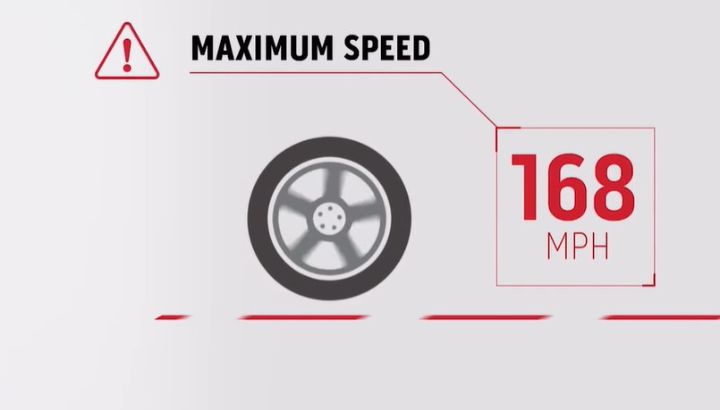
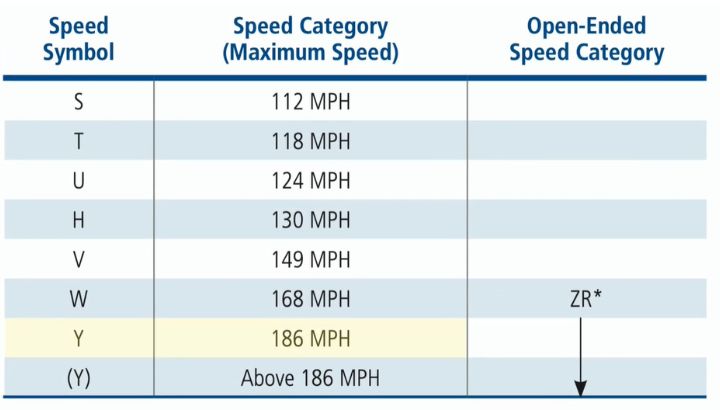
A speed rating is the letter at the end of your tire size code (like 95H or 94V) that shows the maximum sustained speed the tire is rated for. Common ratings: S (112 mph), T (118 mph), H (130 mph), V (149 mph), W (168 mph), Y (186 mph).
If you are wondering what does speed rating mean on tires, the letter you ignored on the sidewall is a hard performance limit set by the manufacturer.
Drop below it, and you are running tires that cannot legally or safely match what your car was built to do. Insurance companies know it. Dealerships know it. Most drivers find out the day a sidewall fails at 80 mph in summer heat. The letter matters more than the size code most people obsess over.
What A Tire Speed Rating Actually Tests And Certifies
A tire speed rating is a single letter at the end of your tire’s size code that certifies the maximum sustained speed the tire can safely handle under specific load and inflation conditions.
The rating comes from laboratory testing under ECE Regulation 30 and ECE Regulation 54 standards, where the tire is mounted on a test wheel and run at incremental speeds for 10-minute intervals until reaching the rated value.
The test simulates 80 percent of the tire’s maximum load capacity, which means real-world performance with a full payload may be lower than the lab rating.
When you ask what does speed rating mean on tires, you are really asking what speed the tire was engineered to survive without overheating, separating, or losing structural integrity. Common ratings go from L (75 mph) for some commercial trailer tires up to (Y) (over 186 mph) for ultra-high-performance summer tires.
The rating system uses letters that mostly correlate alphabetically with speed (S is faster than R, V is faster than T), with a few exceptions like H falling between U and V.
Where The Speed Rating Sits On Your Sidewall
Knowing where to find the speed rating saves you from buying the wrong tire. The letter appears in a specific location on every modern tire.
After The Load Index In The Size Code
The speed rating is the very last letter in your tire’s complete size code.
A tire stamped 225/55R17 95H breaks down as: 225 for section width in millimeters, 55 for aspect ratio, R for radial construction, 17 for rim diameter in inches, 95 for load index (1,521 lbs capacity), and H for speed rating (130 mph).
You should read this code on every replacement tire to confirm the speed rating matches or exceeds your original equipment specification.
On Your Door Jamb Sticker
The placard inside your driver door lists OE tire size including the speed rating.
If your placard reads 225/55R17 95V, you must fit a tire rated V or higher. A V-rated tire matches OE; a W-rated tire exceeds it.
You should never go below the OE rating without explicit dealer or manufacturer approval, especially on performance vehicles.
As Part Of The Service Description
Some tire labels show the speed rating separately as part of the service description, like 95V or 94H.
The number is the load index. The letter immediately following is the speed rating.
You will see this format on premium European tires from Michelin, Continental, Pirelli, Bridgestone, Goodyear, and Dunlop.
In The DOT And Standards Markings
The DOT code on the sidewall confirms the tire meets federal safety regulations including speed rating certification.
Tires sold in the US must comply with DOT FMVSS 139 for passenger tires and FMVSS 119 for light truck tires.
You should also see UTQG ratings (Uniform Tire Quality Grading) for treadwear, traction, and temperature, which complement but do not replace the speed rating.
On Performance Tires As Z, W, Y, Or (Y)
Premium performance tires often show ZR in the size code (e.g., 245/40ZR18) plus a separate W or Y rating.
ZR is a legacy designation indicating speeds above 149 mph. Modern tires use specific letters (W = 168 mph, Y = 186 mph, (Y) = above 186 mph) for clarity.
You will see this on tires for the Porsche 911, BMW M3, Mercedes AMG, Audi RS, Tesla Model S Plaid, and other vehicles where high-speed capability matters.
How Each Speed Rating Letter Translates To Real Speed
Knowing the actual speeds behind each letter helps you match tire to vehicle without guessing.
Common Daily Driver Ratings: S, T, And H
S-rated tires (112 mph) typically appear on economy passenger cars like older Honda Civics, Toyota Corollas, and Hyundai Elantras.
T-rated tires (118 mph) cover most family sedans, minivans, and small crossovers including the Toyota Camry, Honda Accord, Chrysler Pacifica, and base-trim Toyota RAV4.
H-rated tires (130 mph) are common on mid-trim sedans and crossovers like the Nissan Altima, Mazda CX-5, Subaru Outback, and Volkswagen Tiguan.
Performance Ratings: V, W, And Y
V-rated tires (149 mph) appear on sport sedans like the BMW 3 Series, Audi A4, Mercedes C-Class, Lexus IS, and Cadillac CT5.
W-rated tires (168 mph) cover faster performance vehicles including the BMW M2, Porsche Cayman, Mercedes AMG E53, Audi S4, and Ford Mustang GT.
Y-rated tires (186 mph) are for high-end sports cars and supercars like the Porsche 911 Turbo, BMW M5, Mercedes AMG GT, Audi RS6, and Tesla Model S Plaid.
Specialty Ratings: Q, R, And M
Q-rated tires (99 mph) are typical winter and snow tires, since winter driving rarely exceeds this speed.
R-rated tires (106 mph) appear on light truck winter tires and some all-season trailer tires.
M-rated tires (81 mph) are temporary spare (“donut”) tires, designed for limited emergency use only.
Trailer And Commercial Ratings: L, K, And Below
L-rated tires (75 mph) and lower appear on heavy-duty trailer tires, commercial van tires, and some industrial applications.
These tires prioritize load capacity and durability over high-speed performance.
You should never use trailer tires on a passenger vehicle. The lower speed rating combined with stiffer construction creates handling and safety problems.
Ultra-High Performance: ZR And (Y)
ZR is a legacy designation for tires capable of speeds above 149 mph. It often appears alongside W or Y ratings on premium performance tires.
(Y) with parentheses indicates tires capable of speeds above 186 mph, the highest current rating.
You will see (Y) ratings on tires for hypercars like the Bugatti Chiron, Pagani Huayra, and Koenigsegg models, as well as track-focused versions of the Ferrari 812, Lamborghini Aventador, and McLaren 720S.
What Speed Rating Says About Tire Construction And Trade-Offs
Higher speed ratings are not just about higher numbers. They reflect significant differences in how the tire is built and how it behaves on the road.
Compound Stickiness And Wear Trade-Off
Higher speed-rated tires use softer rubber compounds for better grip at high speeds.
The trade-off is faster wear. A Y-rated performance tire might last 20,000 to 30,000 miles, while an H-rated touring tire often lasts 60,000 to 80,000 miles.
You should match the rating to your actual driving. Performance tires on a daily commuter are wasted money in shortened tire life.
Sidewall Stiffness And Ride Quality
Higher-rated tires use stiffer sidewalls to maintain stability at speed.
This stiffness translates to firmer ride quality, sharper steering response, and more transmitted road harshness.
You will feel the difference when switching from H-rated to V or W-rated tires on the same vehicle. The car feels more responsive but also more punishing on rough pavement.
Heat Dissipation Capacity
Higher speed-rated tires use better heat-resistant materials and tread designs.
Heat is the enemy of any tire, and high-speed driving generates extreme temperatures internally.
You should never run a lower-rated tire than OE specification, especially in hot climates like Texas, Arizona, Nevada, or Florida where summer asphalt temperatures can exceed 140°F.
Cost Differences
Higher speed-rated tires cost more.
A V-rated touring tire might cost $130 to $200, while a W-rated performance tire runs $180 to $280, and a Y-rated ultra-high-performance tire often exceeds $250 to $400 per tire.
You should weigh the cost against your actual driving needs. Most drivers never approach the rated speed of even an H-rated tire.
Insurance And Warranty Implications
Fitting tires below your OE speed rating can void portions of your vehicle warranty and complicate insurance claims after accidents.
Some manufacturers (BMW, Mercedes, Audi, Porsche) explicitly require OE-rated tires for warranty coverage on performance trim levels.
You should check with your insurance agent and dealer before downgrading speed rating, even for cost savings.
Why Some Drivers Pick The Wrong Speed Rating
Most speed rating mistakes happen during the buying decision. Knowing the common traps saves you from making them.
Buying By Size Alone Without Checking Rating
If you order a tire by size (225/55R17) without verifying the speed rating, you may end up with a tire rated lower than your OE.
Some shops install whatever H-rated tire fits the size if you do not specify rating, even if your car called for V.
You should always specify the full service description (size + load index + speed rating) when ordering. Example: 225/55R17 95V from Continental ExtremeContact DWS06 Plus rather than just “225/55R17.”
Choosing Lower Rating For Cost Savings
A lower speed rating tire costs less, which tempts cost-conscious drivers to downgrade.
You may save $30 to $80 per tire upfront, but you lose handling precision, high-speed stability, and warranty protection.
You should never downgrade speed rating below OE specification. The savings are dwarfed by the loss of safety margin and the potential insurance complications.
Mismatching Speed Ratings Across Axles
If you have V-rated tires on the front and H-rated on the rear (or vice versa), your vehicle’s handling balance is compromised.
Stability control, traction control, and ABS systems are calibrated for matching tire characteristics. Mismatches confuse these systems and create unpredictable behavior.
You should always run four matching tires of the same speed rating, or pairs of identical rating on the same axle if budget requires partial replacement.
Ignoring Speed Rating On Used Tires
Used tires often appear cheaper but may have lower speed ratings than your OE.
Sellers list size and tread depth but rarely emphasize speed rating, leaving buyers to discover the mismatch after purchase.
You should ask sellers explicitly for the full service description and verify the rating matches your needs before paying.
Going Too High For Daily Driving
Going up a speed rating (e.g., from H to V) is technically safe but rarely important.
The trade-off is faster wear, stiffer ride, and higher cost without practical benefit if you never drive above 80 mph.
You should match the OE rating exactly unless you have specific reasons to upgrade (frequent autobahn driving, track days, performance modifications).
Symptom To Cause To Fix Diagnostic Table
| Symptom On Your Vehicle | Likely Cause | Fix |
|---|---|---|
| New tires feel less responsive | Speed rating dropped from OE | Replace with matching OE-rated tires |
| Highway stability worsened | Lower speed rating tires fitted | Restore OE speed rating |
| Ride became softer than before | Lower speed rating | Restore OE rating for proper damping |
| Tires wearing faster than expected | Higher speed rating than needed | Acceptable trade-off, or downgrade if not high-speed driver |
| Heat blistering on tire surface | Tire run above its rated speed | Replace tire, do not exceed rated speed |
| Sidewall failure at highway speed | Insufficient speed rating | Replace with proper rating, inspect cause |
| Vehicle warranty claim denied | Wrong speed rating fitted | Restore OE specification |
| TPMS warning despite correct PSI | Speed rating mismatch confusing system | Verify rating matches across all four tires |
| Insurance pushback after accident | Tires below OE specification | Document size, rating, and date of install |
| Sluggish handling on European cars | Speed rating below OE V or W | Fit OE-rated tires (Continental, Michelin, Pirelli) |
| Wheel hop at autobahn speeds | Tires beyond their rated capability | Drop speed or fit higher-rated tires |
| Fast wear on track days | Daily-rated tires under track use | Switch to track-oriented Y-rated tires |
How To Verify And Choose Your Speed Rating Correctly
Before you buy new tires, follow this process to make sure you get the right speed rating for your vehicle.
Step 1: Read Your Door Jamb Sticker
Open your driver door and look at the placard on the door jamb or B-pillar.
The sticker shows OE tire size, load index, speed rating, and inflation pressure. This is your baseline specification.
You should photograph this sticker and keep the image accessible. Reference it whenever you order tires online or discuss replacements with a shop.
Step 2: Confirm With Your Owner’s Manual
Look up the tire specification section in your owner’s manual.
This typically lists OE size and rating, plus approved alternatives if any. Some manufacturers (BMW, Audi, Mercedes) list multiple approved speed ratings for different trim levels.
You should follow the highest rating listed for your specific trim. A 2023 BMW M3 calls for Y-rated tires, while a 2023 BMW 330i calls for V-rated tires, even though both are 3 Series models.
Step 3: Check Your Current Tires
Read the sidewall of each tire currently on your vehicle to see what was installed.
Sometimes previous owners or shops fit lower-rated tires to save money. The current tires may not match the OE specification.
You should compare the current rating to the door jamb spec and the manual. If they disagree, the door jamb is authoritative.
Step 4: Match Or Exceed When Buying Replacements
When ordering replacements from Tire Rack, Discount Tire, Costco Tire Center, Les Schwab, Walmart Auto Care, or Amazon, filter by the OE size and minimum speed rating.
Some retailers like Tire Rack let you enter your VIN and automatically filter compatible tires.
You should never accept a lower-rated tire even if it costs less or is in stock. Wait for the right tire or shop elsewhere.
Step 5: Verify At Installation
Before the shop installs your new tires, verify the size and speed rating on the sidewall match what you ordered.
Mistakes happen at the warehouse, in shipping, and at the shop counter. A 5-second check prevents 5 hours of remediation.
You should also confirm the DOT date code is recent (within 12 months) and the load index meets or exceeds OE.
Speed Rating And Vehicle Type Comparison Table
| Speed Rating | Max Speed | Typical Vehicle Type | Example Brands And Models |
|---|---|---|---|
| L | 75 mph | Heavy commercial trailer | Goodyear Endurance ST, Carlisle Radial Trail HD |
| M | 81 mph | Temporary spare (donut) | Most factory donut spares |
| Q | 99 mph | Winter and snow tires | Bridgestone Blizzak DM-V2, Michelin X-Ice Snow |
| R | 106 mph | Light truck winter, some commercial | Continental TerrainContact A/T, Bridgestone Dueler A/T |
| S | 112 mph | Economy sedans | Goodyear Assurance MaxLife, General AltiMAX RT43 |
| T | 118 mph | Family sedans, minivans | Michelin Defender 2, Bridgestone Turanza QuietTrack |
| H | 130 mph | Mid-trim sedans and crossovers | Continental TrueContact Tour, Goodyear Assurance ComforTred |
| V | 149 mph | Sport sedans, performance crossovers | Michelin Pilot Sport All Season 4, Bridgestone Potenza RE980AS |
| W | 168 mph | Performance sport sedans, sports cars | Michelin Pilot Sport 4S, Continental ExtremeContact Sport 02 |
| Y | 186 mph | High-end sports cars, supercars | Michelin Pilot Sport Cup 2, Pirelli P Zero Trofeo R |
| (Y) | Above 186 mph | Hypercars, track-focused vehicles | Michelin Pilot Sport Cup 2 R, Pirelli Trofeo R, Bridgestone Potenza Race |
| ZR | Above 149 mph (legacy) | Performance vehicles using legacy code | Older performance tires, often paired with W or Y |
Tools And Resources Worth Owning
Pick up a digital tire pressure gauge like the JACO ElitePro or Accutire MS-4021B for monthly checks.
A tread depth gauge like the Accutire MS-4350B confirms tread when shopping replacements.
Bookmark the Tire Rack tire size calculator at tirerack.com or 1010Tires.com for size and diameter comparisons. Both tools display speed rating and load index for any tire you research.
Mistakes That Lead To Wrong Speed Rating Choices
Five common mistakes turn a routine tire purchase into a safety or warranty problem. Avoid them and your tires match your vehicle properly.
Trusting Shop Recommendations Without Verification
Shops sometimes recommend lower-rated tires to hit a price point you mentioned.
This is not always malicious, but the result is the same: a tire that does not match your OE specification.
You should bring your door jamb spec to the shop and verify the recommended tire meets or exceeds it. If the shop pushes back on this requirement, find another shop.
Buying Online Without Filtering By Speed Rating
Major online retailers like Tire Rack, Discount Tire Direct, and SimpleTire let you filter by size, but not always by speed rating.
You can accidentally order a lower-rated tire if you do not check the full service description in the product listing.
You should always read the complete tire specification before adding to cart. The speed rating is usually visible in the product title or first specification line.
Mixing Speed Ratings Within A Tire Set
If you replace just two tires due to damage and the new tires are different speed-rated than the remaining two, you create handling imbalance.
Stability control and ABS calibration assumes matching tire characteristics across all four wheels.
You should always replace tires in matching sets, especially on AWD vehicles where mismatched ratings combined with mismatched tread depth can damage the differential.
Going Below OE Specification To Save Money
A lower speed rating saves $30 to $80 per tire but compromises high-speed stability, handling response, and warranty protection.
The savings often disappear in faster tire wear or insurance complications after an accident.
You should never downgrade rating without explicit manufacturer approval. Stick to OE or higher, even if the budget is tight.
Ignoring Speed Rating On Performance Vehicle Replacements
If you drive a BMW M3, Mercedes AMG, Audi RS, Porsche 911, or similar performance vehicle, the OE speed rating is critical.
Fitting an H-rated tire on a vehicle that calls for Y-rated tires creates a serious safety mismatch at high speed.
You should never compromise on rating for performance vehicles. The Y rating is there because the engine, brakes, and chassis can produce speeds that lower-rated tires cannot survive.
Habits That Help You Choose Speed Rating Correctly Every Time
If you build these habits, your tire purchases match your vehicle perfectly for the next decade.
Always Match The Door Jamb Specification
Treat the door jamb sticker as the authoritative specification, not the owner’s manual or a shop’s recommendation.
The placard reflects exactly what the manufacturer engineered the vehicle to use, accounting for trim level and option packages.
You should photograph the placard the day you buy the vehicle and reference the image when shopping tires.
Buy From Retailers That Respect OE Specifications
Discount Tire, Costco Tire Center, Les Schwab, and Tire Rack typically respect OE specifications and will not install lower-rated tires without explicit customer approval.
Some chain shops and dealerships are more flexible, which can mean either better service or worse.
You should ask the shop directly: “Does this match my OE speed rating?” If they cannot answer confidently, find another shop.
Stay With OE Or Higher For Performance Vehicles
If you drive a sport sedan, hot hatch, or performance vehicle, fit OE rating or higher every time.
The cost difference between V and W rated tires is rarely more than $30 to $50 per tire, and the safety margin is significant.
You should never settle for “close enough” on performance vehicles. The handling and stability benefits justify the premium.
Keep Records Of What Was Installed
Save receipts and photos of every tire purchase including the full service description.
This documentation protects you in warranty disputes, insurance claims, and resale value discussions.
You should keep digital records for at least the life of the vehicle plus 2 years for warranty purposes.
Real Life Scenario
You drive a 2021 Audi A4 Quattro. You check the door jamb and find it calls for 245/40R18 97V Continental ExtremeContact DWS06 Plus tires.
You shop online and find an in-stock deal on 245/40R18 97H at $150 each (saving $80 total over the V-rated option at $170 each).
You decide against the H-rated tires because they fall below the OE specification.
Instead, you order 245/40R18 97V Michelin CrossClimate 2 at $185 each from Tire Rack with shipping to a partner installer for $25 mounting and balance per wheel.
Total: $840 for tires, $100 for mounting/balance, $0 for TPMS reset. Your warranty stays intact, your handling matches the OE engineering, and your insurance has no grounds for dispute after any future incident.
If you had chased the cheaper H-rated option, you would have saved $80 upfront but lost the safety margin and potential warranty protection that justify the premium.
Frequently Asked Questions
What Does The Letter At The End Of A Tire Size Mean?
The letter at the end of a tire size code is the speed rating, which certifies the maximum sustained speed the tire can safely handle.
Common ratings include S (112 mph), T (118 mph), H (130 mph), V (149 mph), W (168 mph), and Y (186 mph).
The rating is set by laboratory testing under ECE Regulation 30 standards and applies under specific load and inflation conditions.
You should match or exceed the rating shown on your door jamb sticker when buying replacements. Going below OE rating compromises high-speed stability, handling response, and warranty protection. Ratings range from M (81 mph) for spare tires up to (Y) (above 186 mph) for hypercars.
Can You Use Tires With A Lower Speed Rating Than OE?
You can technically install tires with a lower speed rating than OE, but you should not.
Lower-rated tires compromise high-speed stability, handling response, and structural integrity at sustained speeds.
Some manufacturers (BMW, Mercedes, Audi, Porsche) explicitly require OE-rated tires for warranty coverage. Insurance companies may also push back on accident claims involving downgraded tires.
You should always match or exceed the OE speed rating on your door jamb sticker. The cost savings of lower-rated tires (typically $30 to $80 per tire) are dwarfed by potential warranty losses, insurance complications, and safety margin reduction. Stick with OE specifications for predictable handling and full coverage.
What Speed Rating Do I Need For My Car?
You need the speed rating shown on your driver door jamb sticker, which reflects the manufacturer’s engineering specification.
For most family sedans and crossovers, this is H (130 mph) or T (118 mph). Sport sedans like the BMW 3 Series or Audi A4 typically call for V (149 mph). Performance vehicles like the BMW M3 or Mercedes AMG require W or Y ratings.
Trucks and SUVs vary widely based on trim level and intended use.
You should never go below the OE rating but can go higher if desired (with the trade-off of faster wear and stiffer ride). Check the placard, owner’s manual, and current tires to confirm the right specification for your vehicle.
Does Speed Rating Affect Tire Lifespan?
Yes, higher speed-rated tires typically wear faster than lower-rated tires.
Performance compounds optimized for high-speed grip use softer rubber that wears more quickly. A Y-rated tire might last 20,000 to 30,000 miles, while an H-rated touring tire lasts 60,000 to 80,000 miles.
The trade-off is grip and high-speed stability versus tread life.
You should match speed rating to actual driving needs. If you never exceed 80 mph, an H or V-rated tire delivers everything you need with longer life. If you frequently drive at highway speeds in summer or take track days, the higher rating is worth the faster wear. Touring tires like Michelin Defender 2 balance both.
What Happens If I Drive Above My Tire Speed Rating?
If you drive above the speed rating, your tire generates excessive heat that can lead to tread separation, sidewall failure, or blowout.
The rating is a safety threshold based on laboratory testing under controlled conditions. Real-world factors like under-inflation, heavy loads, and high ambient temperatures can lower the actual safe speed.
You should never sustain speeds above your tire’s rating, especially in summer heat.
In hot climates like Texas, Arizona, or Nevada, where summer asphalt temperatures exceed 140°F, the margin between safe and unsafe shrinks dramatically. Insurance and warranty claims after high-speed incidents on incorrectly rated tires often face complications or denials.
Are Higher Speed-Rated Tires Worth The Extra Cost?
It depends on your vehicle and driving habits.
If you drive a performance vehicle that calls for V, W, or Y-rated tires from the factory, fitting those tires is mandatory for proper handling, warranty compliance, and safety.
If you drive a daily commuter and never exceed highway speeds, going from H to V offers minimal practical benefit and accelerates wear.
You should match the OE rating exactly unless you have specific reasons to upgrade (frequent autobahn driving, track days, performance modifications). The cost difference between adjacent ratings is typically $30 to $80 per tire. The handling difference is noticeable on performance vehicles but subtle on family sedans.
Can Mixing Speed Ratings Damage My Vehicle?
Yes, mixing speed ratings on the same vehicle can compromise handling and electronic stability systems.
Stability control, traction control, and ABS systems are calibrated for matching tire characteristics. Different speed ratings mean different sidewall stiffness, compound, and grip levels, which confuse these systems.
The mismatch is most dangerous on AWD vehicles where it can damage the transfer case and differential.
You should always run four matching tires of the same speed rating. If budget requires partial replacement, fit identical pairs on the same axle and plan to replace all four within 5,000 miles. Tire shaving (machining new tires to match existing tread) is an option for AWD vehicles needing single-tire replacement.
How Do I Find The Speed Rating Of My Tires?
The speed rating is the last letter in your tire’s size code on the sidewall.
A tire stamped 225/55R17 95V breaks down as: 225 mm width, 55 aspect ratio, R radial construction, 17-inch rim diameter, 95 load index, and V speed rating (149 mph).
Some tires also show ZR before the rim diameter for legacy high-performance designations.
You should check all four tires plus your spare. Mismatched ratings within the same vehicle indicate previous shop work that may not match OE specifications. The full service description includes the load index number and speed rating letter together (95V, 94H, 91Y, etc.). Always read the complete code before buying replacements.
Does Speed Rating Change With Tire Age?
The speed rating itself is a permanent specification of the tire.
However, an aging tire may not safely sustain its rated speed because the rubber compound has hardened, sidewalls have weakened, and overall structural integrity has declined.
A V-rated tire from 2018 may technically still be V-rated in 2026 (if within the 6 to 10 year safe age limit), but treat it more cautiously at sustained high speeds.
You should follow manufacturer age recommendations: replace at 6 years regardless of tread, with a hard cap at 10 years. The DOT date code on the sidewall (last four digits) tells you when the tire was manufactured. An old V-rated tire is still V-rated on paper, but the practical safety margin shrinks with age.
Conclusion
What does speed rating mean on tires comes down to a single letter that defines what your tire was engineered to survive: S for 112 mph, H for 130 mph, V for 149 mph, W for 168 mph, Y for 186 mph, and (Y) for anything above that.
Match the rating on your door jamb sticker exactly when buying replacements. Going higher is acceptable if you accept faster wear. Going lower compromises high-speed stability, handling response, and warranty protection that you paid for when you bought the vehicle.
Drivers who match OE specifications rarely think about speed ratings again. Drivers who chase the cheapest tire on the wall usually find out what the rating actually means at exactly the wrong moment.
The letter is small. The consequences are not.